


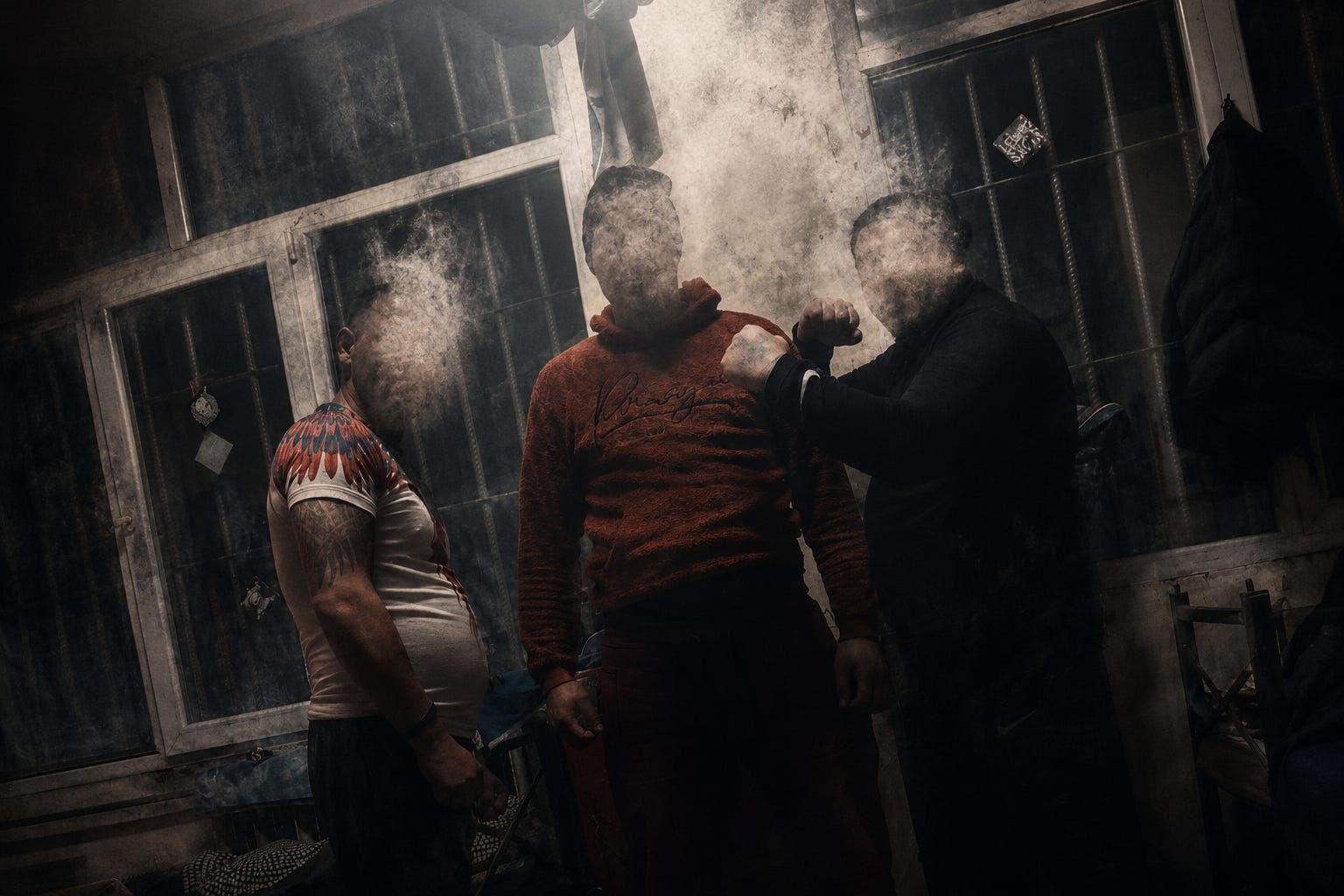
There was a Facebook video call a few years ago that has stayed with us.
It was taken during one of the tribe’s celebrations, and Sadik was calling his mother.
This was significant because Sadik was in prison. He had been there for years, with only short periods of freedom in between. His daughter was still a child the last time he had seen her properly. Now she was fifteen.
His mother turned the phone around so he could see her and the girl stood up and started dancing.
Sadik is known in the tribe as one of the best dancers. His daughter was dancing in front of him, now grown. She was dancing like a Goddess, already known as one of the best in the tribe, just like her father. But as amazing as it was to watch her, watching Sadik’s face on his mother’s phone screen was what stayed with us. He had a wide smile, beaming with pride, and tears flowing down his face with unspeakable sorrow.
There is a tendency, when we talk about prison, to imagine the crime first and the human being second.
So let us start with something that may surprise you.
Sadik was not in prison for murder. He was not some spectacular criminal who had committed an extraordinary crime.
He was there because of petty theft.
In many Balkan Romani communities living in poverty, when a man spends years going in and out of prison, the thing that started the cycle is very often not some spectacular crime at all. It is a phone, a bicycle, a piece of jewellery. Something taken from the street. Something that can be sold quickly enough to put some money in your pocket today.
And by the time the man is sitting behind bars watching his fifteen-year-old daughter dance on a phone screen, the original object he stole can feel almost absurdly insignificant compared to what has grown around it.
The thing people expect us to say about prison
There is a very particular social meaning attached to prison in mainstream society.
Anyone who goes to prison is marked by it. The family is ashamed, and often even abandon their imprisoned relative. Once the inmate is out, they enter a cold society who now looks down upon him and keeps a distance. Finding a job, or a social circle, is even harder than serving the sentence. The entire event can become a kind of moral dividing line: this person crossed over there, into a category called “criminal,” while the rest of us remain safely on this side.
In the Balkan Romani communities living in poverty, it does not work this way. A man who has been to prison is not automatically rejected by his community. He is not treated as though he has permanently fallen out of society. He comes back and sits at the table. He attends celebrations. His mother cries for him. His wife waits for him. His children visit him. While he is inside, they do everything in their power to support him and visit him as often as possible.
And when he comes home, people generally know exactly what he has been through.
The prison sentence is not a source of shame. It is, however, a source of sorrow. That difference is difficult to understand until you understand what people are being imprisoned for.
Because, again, we are not primarily talking here about spectacular crimes. We are talking about petty theft.
We actually wrote about this years ago, because the stereotype that Roma are “thieves” is one of the oldest and most persistent stereotypes attached to the community. The honest answer to “does theft happen?” is yes. But, as we wrote then, that answer is also incomplete and lazy. Poverty and social exclusion contribute to higher rates of criminal activity among Roma populations, just as they do among other populations living in poverty.
The question that matters is what kind of theft we are talking about, and why it happens.
Our piece “Are the Roma Thieves?” is included in the e-book we published about the most common stereotypes against the Roma and the reality behind them.
When the Truth Does Not Sound True
You can buy the book at the link above for just 14.99 or you can claim our Autumn Offer which is running for the next two weeks: If you become an annual subscriber for our publication, you will receive — among all the perks paying subscribers get — our two published e-books for free.

“The Roma steal to survive”
In our previous piece, Pepi put it very simply: “The Roma steal to survive and to feed their children. It’s as simple as that.”
That sentence sounds shocking if you take it out of context. It is also not a universal statement. Most poor Roma do not steal. But there is a particular kind of petty theft that exists at the intersection of poverty and desperation, and in communities where poverty has lasted for generations, people understand exactly what that intersection looks like.
A family needs money today. There is no work, no income, all usual ways of making money (selling material for scrap, for example) have dried up. The children are starving or someone needs medical attention or the loan shark you borrowed from is now threatening to rough you up. All of these scenarios are everyday reality for the Balkan Romani community living in poverty. Of course, this doesn’t make all of them steal.
But some of them look at one thing sitting somewhere that can become cash right now.
It is usually not a life-changing amount of money. That is almost the point.
A phone, a bicycle, a golden necklace. Something that can be sold and turned into food, a paid loan for the week, medicine, or whatever else is needed right now.

In our older article, we wrote about what is and is not considered acceptable within the community itself. Theft from someone who is visibly vulnerable is viewed very differently. The idea is that you take from a source perceived as abundant, and you do not deliberately destroy someone who has nothing.
Of course, if you are the one stolen from, it is infuriating. You paid for something with your own money that you earned, probably even had to save for it, or even worse: it was something of sentimental value. A golden bracelet from your grandmother, a gift from a spouse. And then someone just takes it.
The biggest mismatch between this sentiment and the world-view of the Roma living in poverty, is that it doesn’t matter if you can restore it. If you are employed and can save again and buy it again, then you are already so much better off than the poor person that you are, from their perspective, living in a different Universe. If your phone gets taken, you will not starve. Your children will not starve. Your knees will not be broken by a loan shark. And, above all, you can buy another phone. It will be an expense, but you can do it without it destabilising your entire household. This is how the Roma living in poverty see it.
Romani tribes applied these same value system during their nomadic days, before nomadism was outlawed across Europe. They were often persecuted, with the same zest we see today, for stealing chickens and letting their horses graze in other people’s land. Jan Yoors describes a conversation with a Roma boy about this exact thing in his book, “The Gypsies.”
“Putzina explained to me that stealing was not really a misdeed as long as it was limited to the taking of basic necessities, and not in larger quantities than were needed at that moment. It was the intrusion of a sense of greed, in itself, that made stealing wrong, for it made men slaves to unnecessary apetites or to their desire for possessions.
Gleaning a little dry wood for the fire, from the forest, was no misdeed. There so much of it, and anyway, if they did not take it, it was left to rot. Putting a few horses to pasture overnight in someone’s meadow was not that bad. Grass grew without the owner’s active contribution or effort.”
From our piece “Are the Roma thieves?”
What can be most infuriating for an outsider, on an emotional level, is the question of sentimental value. The Roma don’t attach sentimental value to possessions and perhaps that makes it so much easier for the desperate Roma living in poverty to steal something that, to the victim, is much more cherished due to its history than to its monetary value.
To the Balkan Roma, a wedding band means nothing. The bond between husband and wife is not governed by a piece of metal. Even when the Roma buy and exchange wedding bands for a wedding ceremony, they don’t think twice about pawning them when they need money. A golden bracelet or ring from an older relative is also seen as valuable, but not as something to hold onto. Of course they hold onto it if they can, but if they need money urgently and don’t have other ways to obtain money, they pawn it with the full knowledge that the relative would have wanted them to. This is why gold is given as a gift to relatives and children in Balkan Romani communities. Not for its beauty but for survival.

So again, stealing something of monetary value has nothing to do with its sentimental value, when the question of survival overwhelms everything else.
The sacrifice
A man who steals risks prison. He knows it. Petty theft is like gambling. You roll the dice, you take the risk, and sometimes you lose.
Except that the thing you lose is not money; it is freedom. And, very quickly, it becomes something else too. Your family.
The people we are talking about here are overwhelmingly men because in these families the provider role is overwhelmingly placed on men. They are the people who are expected to bring something home. There is enormous internal pressure attached to that. When there is nothing, the pressure does not politely wait for another employment opportunity.
And when a man reaches the point of taking the risk of petty theft, he is gambling not only with his freedom but with his ability to continue being the person who provides for his family. This is a very conscious risk and one not taken lightly. It is absolutely seen as a sacrifice both by the person stealing and by his family and community.
This is something that is difficult to see from the outside. The man goes behind bars but his wife still has to survive without him. His children still need everything children need. But if the family can, they will also spend money on the man in prison. They will bring him essentials, cigarettes, they will try to make sure he has what he needs.
And he knows it.
This is why, when imprisoned men talk about what hurts, it is not always simply “I am in prison.” It is also “I am supposed to be the one bringing something home.” They hurt much more about the children and wife struggling outside. The sorrow comes from the reversal: the provider has become a burden.
What happens to the family outside is a much heavier verdict to the inmate than the loss of freedom they experience inside.
A QUICK NOTE BEFORE THE ARTICLE CONTINUES
Džansever Dalipova, recognized as the Queen of Romani music here in the Balkans, passed away in August 2026. This month, in her honor and memory, we are dedicating each of our pieces to songs, in which she explored the true, unfiltered life of her fellow Roma. Queen Džansever’s songs are all full of soul and raw truth. In our pieces, we will aspire to do her songs justice.
You can listen to the song that inspired this piece, along with its English translation, below.
The men who steal too little
In Bulgaria, police and prison guards have used the derogatory term kokoshkari for Roma thieves, literally “chicken-men,” referring to men who steal small things. The implication is that they are pathetic little thieves, not serious criminals.
Jan Yoors talks about the same phenomenon in “The Gypsies”.
The Roma have always been seen not just as thieves but as thieves who steal too little. This, as we illustrated, is in accordance with their value system. They deliberately do not take too much.
Ironically, this is only met with bigger contempt by society. Bigger or white-collar crimes, conspiracies, bank robberies: this inspires curiosity and countless movies. We enjoy these movies too, make no mistake. The appeal here is the enormous intellect required to pull off something grand, to outsmart the “system.”
A Roma living in poverty, however, stealing a phone: this is seen as pathetic. So they deserve all the punishment they can get. Right?
Of course, petty theft requires a lot more courage than a grand conspiracy you elaborately prepare for; it requires incredible “street smarts”, and we can argue that both the sacrifice and stakes are bigger. But this is not about defending petty theft. It is about highlighting the disproportionate zest of the justice system to punish and punish people who try to survive in poverty, and society’s disdain for crimes that are more annoying than life-altering.
What happens behind prison walls
Once you go behind bars, you enter a very different world, with its own hierarchy and survival rules.
“There are three types of inmates,” one of Pepi’s nephews was explaining once. “The Bosses, the Brides, and the Hustlers.”
The Roma overwhelmingly belong to the Hustlers. Street-smart, quick on their feet, witty, and often forcibly recruited by the Bosses, the ones imprisoned for serious crimes and with ties to organised crime.
