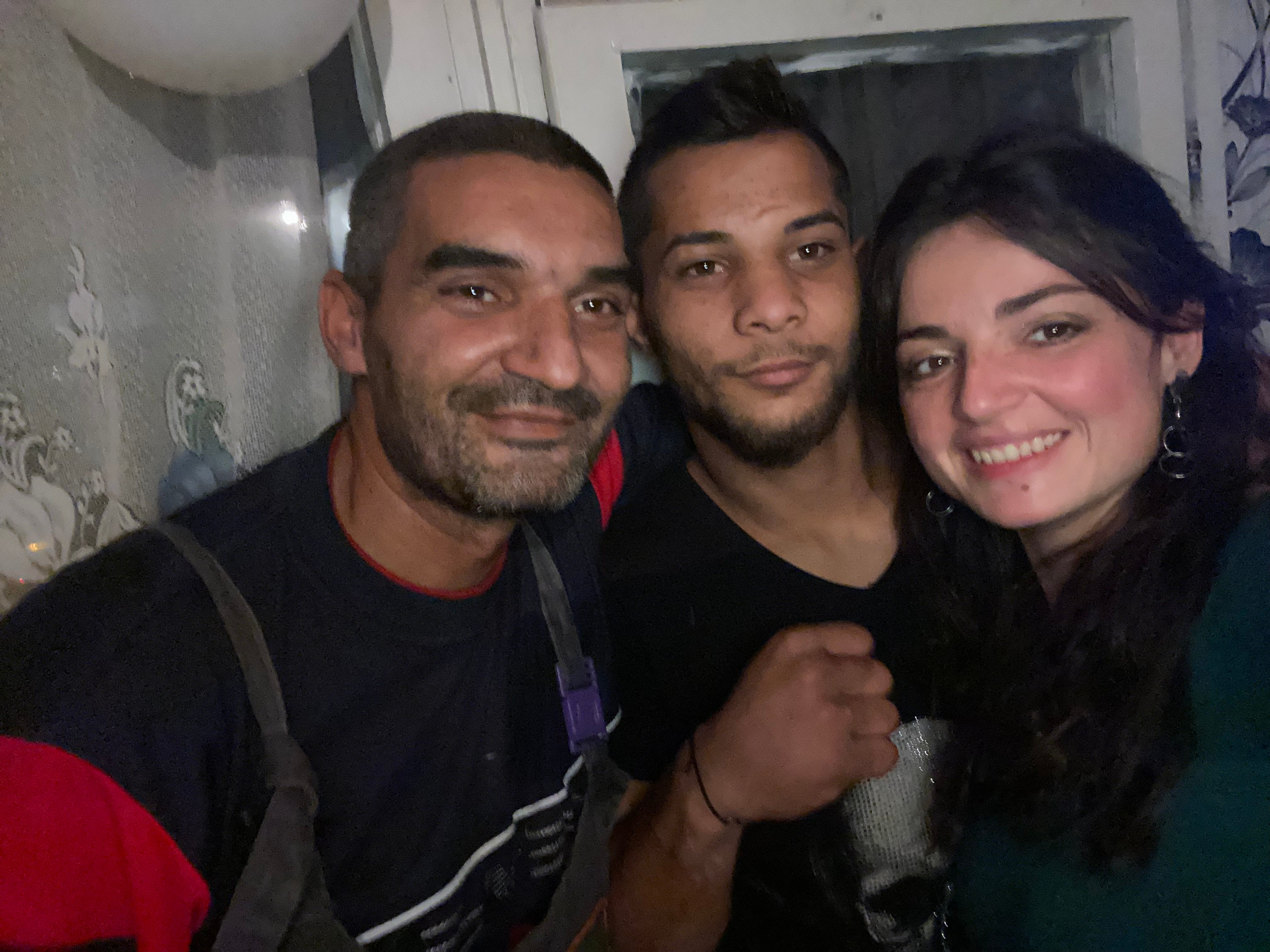
Martina’s very first contact with the Romani community of what would end up to be her future husband Pepi, was in a cold February day in 2020. The community had suffered the demolition of their homes, and were now placed in the administrative building of a crisis center. Martina was part of a NGO who went there, for their first visit, to organise educational activities for the children.
It shaped up to be a complete failure. The room designated by the director of the center was locked. Nobody was there from the admin team to unlock it or help gather the children. The few Roma in sight, already having seen all kinds of clowns and show-offs waltz in under the banner of “charity”, were completely uninterested in the volunteers and whatever agenda they had. Still, the organisers were determined to gather some children, so they stopped one of the mothers walking down the corridor—Maria, one of Pepi’s many adult nieces—and asked her for help.
This was in the in the damp and dark corridors of the crisis center building. Several children were gathered around Maria and looking at the volunteers with curiosity, but otherwise the corridors felt empty. The only sign that 30+ Romani families were housed in the building was the vibration of a powerful bass system coming from one of the higher floors.
“We have prepared activities for the children,” explained the organiser. “Can we gather them?”
“I can’t gather all the children,” Maria said.
“Could we talk to some of the other parents?” Asked the organiser.
“No,” Maria said and looked at the volunteers as if they were crazy. “They are celebrating.”
Naturally, for the volunteers, a “celebration” was no reason at all to not send the children to read some books for one hour. The bass that seemed to be shaking the entire building was enough indication that this was not a children-style celebration.
But Maria cut short any attempt to interrupt the adults who were “celebrating”. And many months later, when Martina started getting to know the community as Pepi’s partner and not as part of a volunteer group, she learned that this type of protective wall always surrounds the people who sit down “to drink." Maria’s wording, “They are celebrating” was actually a softened and diplomatic framing, meant for outsiders. Among the community, she’d have used the much more direct “They are drinking.”
“He’s drinking” is enough of a statement among the Roma to indicate to someone that the person in question is not to be disturbed. Whatever business you have with them, it can wait. It doesn’t matter how important it is to them or to you.
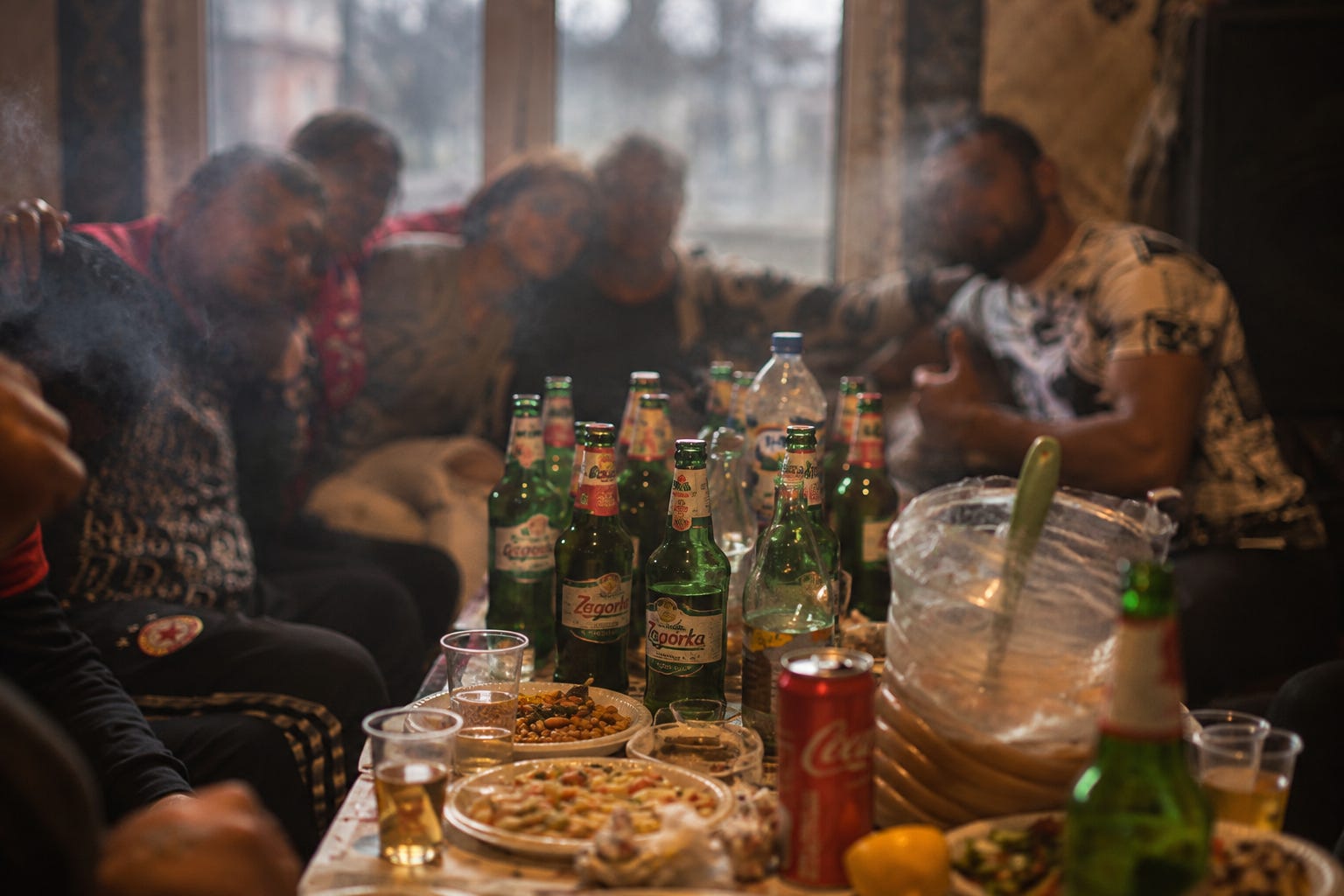
The drinking itself is very extreme to outsiders who are more accustomed to having a glass of wine or 1-2 beers every now and then, or a drink to unwind in the evening. The Balkan Roma are “all or nothing” about drinking. They go long stretches without drinking and, actually, consider a single glass of alcohol every day to be the unhealthy thing. But when they “sit down to drink”, they get drunk, most times even black-out drunk.
What outsiders can glimpse from these “celebrations” is usually met with severe judgement. The music is always loud and, quite literally, causing the walls to shake. If there are framed pictures on the wall or glasses arranged on shelves, they will fall. More often than not, police gets involved because surrounding (non-Roma) neighbours complain about the noise and loudness. Very often — all too often from the perspective of a non-Roma outsider — fights break out during these “celebrations.” One moment people are dancing, the next: a physical fight erupts.
Due to the big amounts of alcohol, the severity with which people consume it, the deafening music, and the physical violence that happens with high frequency, Romani gatherings are viewed as extreme, savage, and wild.
For sure, to an outsider, the way the Balkan Roma consume alcohol is not how alcohol is supposed to be consumed.
But outsiders see only the loudness: the music, the fighting, all the things that bubble up to the surface and reach the eyes of other people. What actually lies beneath this surface is the exact opposite of what outsiders assume about Romani drinking culture.
The Roma approach drinking with reverence, almost like a spiritual ritual. It goes way beyond “unwinding” and “fun”, although these element play a part too. But in the context of generational poverty and complete, centuries-long social isolation, for Balkan Romani communities alcohol opens the door to a state of complete surrender. They do not consume alcohol for the sake of alcohol or getting drunk, it is with the very conscious purpose of emotional processing. In Romani communities that experience a lot of trauma but have no access to what mainstream society would call “mental health support”, there is an entire culture around not suppressing emotions but channeling and releasing them.
There are four ingredients for this release and they are all meant to remove psychological defensive barriers so you can get in touch with your emotions, let them pass through you, and release them so they don’t poison you. This way, you can face another day.
The first ingredient is the loud Romani music that, through the bass and rhythm, puts you in a state of trance.
Number two is the dancing, the looked-down-upon “kyuchek” which, at least for the Roma in our geographical region, is entirely located in the hips: one of the key areas in the body where “trauma is stored”, or to be more precise, where trauma causes tightness in the body.
Number three is the alcohol, the best and fastest way to lower defences and inhibitions.
And number four is the most important ingredient: The community. The people you drink with. Everything else falls apart very quickly if this ingredient is even a little bit off.
Entering this space is sacred for the Balkan Roma. It is not something you do lightly, it is treated with reverence, and it is very fiercely protected both by the people participating in the “drinking” and by the surrounding community: they deliberately block access to the drinking relatives. The intensity and sacredness is why, to the Roma, drinking every day (even if “just a bit”) is non-sensical. Ironically, this is also why fights break out: the zero tolerance to disturb the process that is unfolding beneath the surface. But the nuance here is big and largely invisible to outsiders.
A QUICK NOTE BEFORE THE ARTICLE CONTINUES
Džansever Dalipova, recognized as the Queen of Romani music here in the Balkans, passed away in August 2026. This month, in her honor and memory, we are dedicating each of our pieces to songs, in which she explored the true, unfiltered life of her fellow Roma. Queen Džansever’s songs are all full of soul and raw truth. In our pieces, we will aspire to do her songs justice.
You can listen to the song that inspired this piece, along with its English translation, below.
What are the Roma “celebrating”?
Balkan Romani gatherings and celebrations always carry incredible intensity. The “fun” part is unmatched by anything you can encounter in a mainstream context. The music and dancing, even if you are just observing and not participating, can feel otherworldly. The thing is, you have to be inside it. When you are outside, the bass and shaking do feel very disruptive. You might wonder how are the people there not getting headaches and what is even the point when you can’t hear your own thoughts let alone what the person next to you is saying.
When you are inside it though, you get it. The music puts you in a very specific internal state, and the surrounding people are there to protect this state.
Of course there is conversation, jokes, and laughter at the beginning of every gathering. However, gradually, the music gets louder, the bottles get empty, and the celebration reaches its peak, where things move beyond conversation.
You can get an idea of this fun part of Romani parties from some of the clips we’ve posted on our social media: here, here, here, and here.
Then there is the flip side, the deeper reality unfolding during these gatherings. When you combine the music, the alcohol, and the community, you open the door to your own inner reality.
“During our parties, you can have one person dancing and the one next to them crying their eyes out. One doesn’t cancel out the other. Or the same person would be crying now, then dancing 10 minutes later. It’s all part of the same experience.”
Pepi Mustafov, co-author of The Sky and Earth Know
For the Balkan Roma, the good and the bad, the happiness and the sorrow, all exist together. You don’t hide one to acknowledge the other. Anything that has been weighing on you, consciously or not, will surface during these celebrations. It could be something that happened recently or something from long ago. It doesn’t matter and nobody questions it or judges you for it. If you start crying about your father who passed away when you were a kid 20 years ago, nobody will even think to imply you should have “gotten over it by now.” The community understands very well how grief works. And if anyone is crying while others are laughing or dancing, nobody would think to tell you to “cheer up” or “not spoil the mood.” The “mood” can be anything that comes to the surface, not something that should be artificially maintained.
So, when we say “celebration”, we mean something very different from what mainstream culture considers “celebration.” In the mainstream context, you celebrate a specific person or occasion, the attention is dedicated there, and you are meant to keep your focus and your mood at this exact level. For the Balkan Roma, the occasion is the opening gate for the gathering. A wedding, a birthday party, or the welcoming of a newborn are the three big reasons for a big Romani event. The community makes a big deal to honour the person being celebrated, and this can last hours. But it is also understood that after a certain point, the celebration moves into a different domain.
When Martina and the volunteer group first entered the crisis center in February 2020, there was no wedding or birthday. So what were the Roma celebrating? The answer is, it doesn’t really matter.
The “occasion” could be anything. Someone got their salary today. Someone started playing music and people just naturally started gathering around them. Or, simply, someone felt the need for the experience of a catharsis: so they pawn their phone, buy alcohol, and gather a couple of people to drink with. Then the day, evening, and night begin unfolding and taking a life of their own.


Why do fights break out at Romani parties?
Let’s begin with an obvious but necessary distinction. The Roma do not enjoy fights at celebrations. They consider it distasteful and, if a fight happens, they consider the night to have been ruined. Contrary to what outsiders might assume, a fight is not what the Roma are itching for when they start drinking and listening to loud music.
There is an unspoken understanding among Balkan Roma that when a group of people is drinking together, a shared atmosphere of vulnerability emerges. Emotions run deep and you never know what the person next to you might be going through in this exact moment. They could be laughing, grieving, processing a fight with a spouse or a child—just anything really.
What is difficult to put into words about Balkan Romani gatherings is the sense of absolute fluidity that runs through the room, as if every person is carried by a wave. If someone is drunk enough to lose their balance, at least two people will jump up, steady them, and sit them down. There is a constant current of instinctive care.
And the golden rule is, you do not bother anyone. You do not tease, do not provoke, do not disrupt. If you do that, you will face a strong wave of resistance.
For Martina, the first time she witnessed that was at a birthday celebration with Pepi’s tribe back in October 2021. She was sitting next to one of Pepi’s adult nephews, Urko, when a group of people from a related tribe showed up, arriving two hours after everyone else. One of them made a comment how there was no room left, even though people were shuffling to make room. He kept making pointed comments, basically mocking the hosts for the very small space they had. Martina only knows this now because Pepi translated it afterwards, but at the time, what she saw was people increasingly getting sharper and sharper. They spoke firmly to the guy, then a few of them raised their voice. All of this, it turned out, was them warning him to stop pressing and to sit down and join them or leave. When he didn’t, one of the men stood up, his body language screaming that he was ready to fight. Everyone around him started shouting “Stop, stop”, so that he doesn’t start a physical altercation. During the entire time this was unfolding, Urko had placed his hand around Martina’s shoulder, knowing full well that she can’t understand a word and is witnessing an escalating argument without having any context. It was a reassurance, a non-verbal “Don’t worry.” Finally, both men sat down and the evening continued without problems. But the tribe had made sure that no humiliating comments are made towards the hosts and that they would be treated with basic decency.
It is this decency, the minimum form of respect for another’s comfort and peace of mind, that the Roma protect fiercely during gatherings when inhibitions are lowered and emotions run deep. They do not tolerate mocking, humiliation, or provocation.
Fights erupt only as a last resort. Only when someone’s provocations have not been stopped by any argument, any boundary, any warning, any attempts to defuse the situation. Even if one person is quick to attempt a physical fight, the others would restrain him. Fights are avoided at all cost.
The difference between (Balkan) Romani culture and mainstream culture is that, as much as the Roma do not want any fighting, they would never swallow insults and provocations just to keep the peace. They will immediately draw a boundary and warn you a hundred times before anyone is hit, but they will not just sit and “take it” to maintain an artificial good mood. In mainstream culture, we are accustomed to tolerating rude behaviour and insults. The Roma are not.