


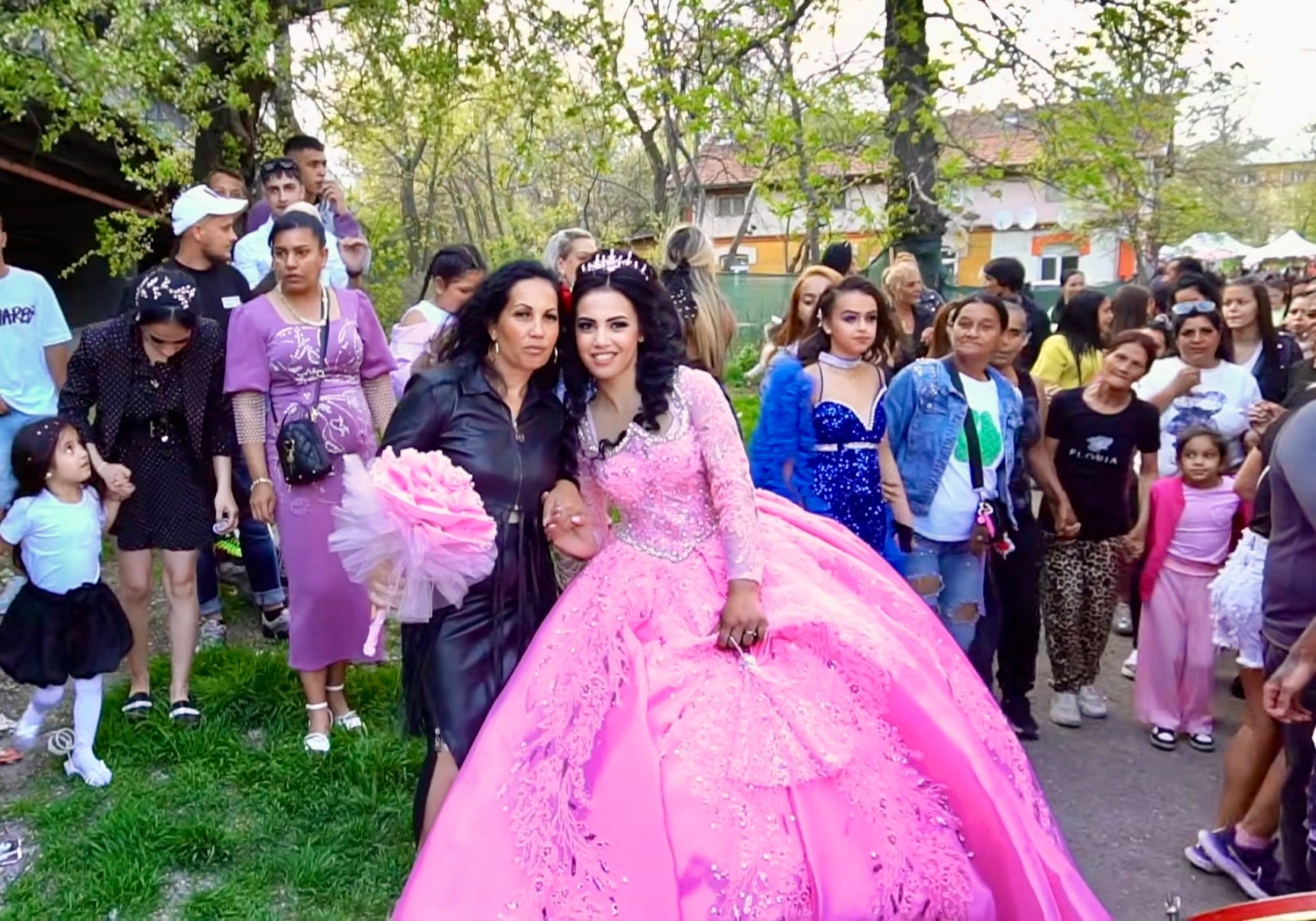
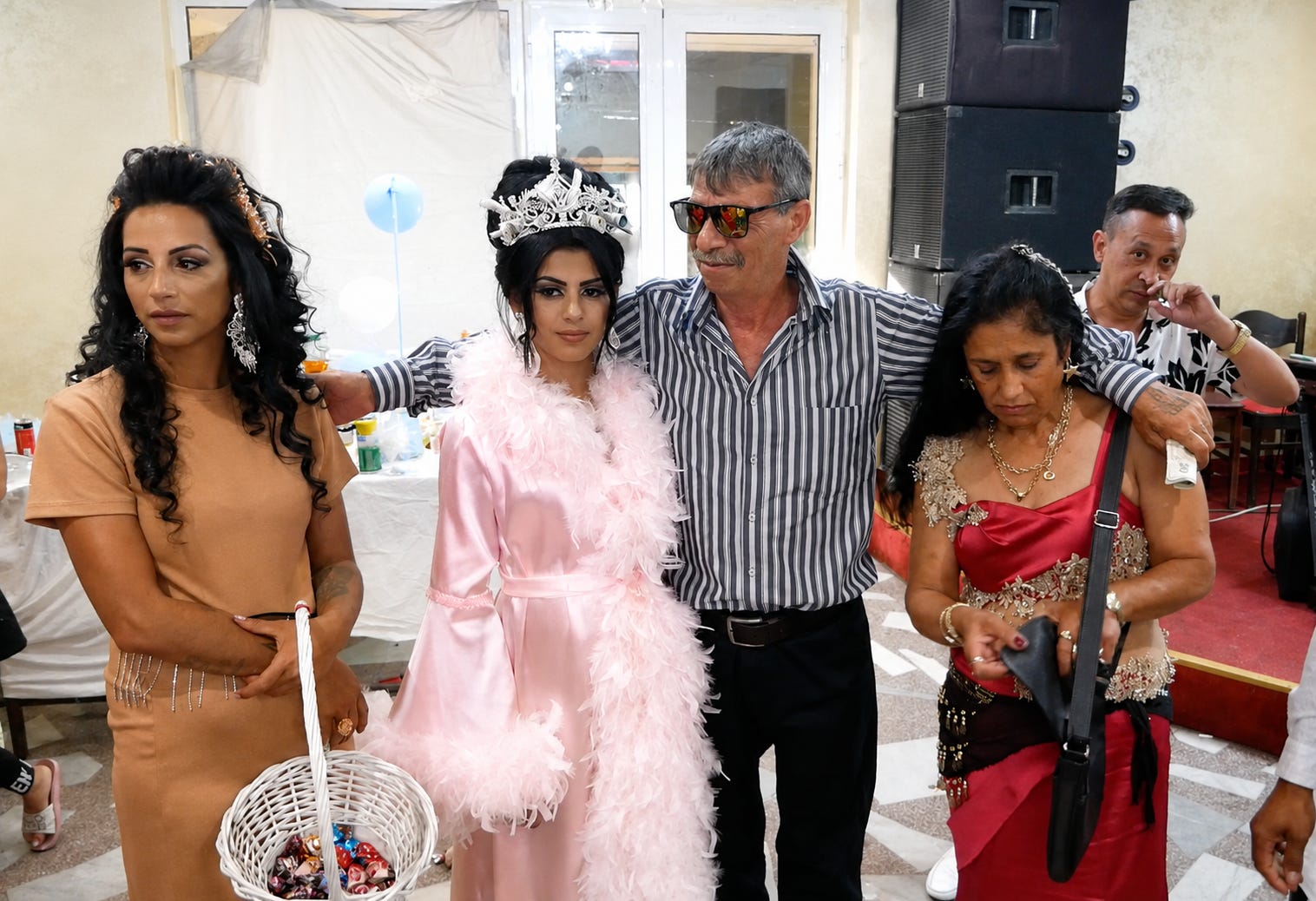
Recently, we published a video on our Instagram profile, showing Vessi — the beautiful bride you see in the picture above — with her father leading the traditional “horo” dance at her wedding.
Some lady from Croatia left a comment which she subsequently deleted. It said: “At least other people in the Balkans wear normal wedding dresses.” That was in response to our caption that Vessi’s dress is pink, one of the three traditional colors in Balkan Romani weddings. And, pink is, we infer, “abnormal” in other, “normal” weddings. As we all know, only white is normal.
Of course, the white wedding gown is a very new, and Western, element of weddings here in the Balkans.
Here is what “normal” actually looked like, for centuries, in Balkan weddings.


Color is powerful and carries immense symbolic significance. Especially in a wedding: perhaps the most important ritual in every culture, a ritual of union and laying the foundations for the future.
And for the Roma, this understanding of the symbolism of color is very much alive in traditions not only centuries ago but also today. In fact, it is the gravitational center of every Romani wedding.
The three colors
Traditional Balkan Romani weddings last for three days and the bride wears a different dress each day.
Considering the comment we quoted from the Croatian lady, we are amused to report that the wedding gown on the first day is… drum roll… white.
The symbolism? The same symbolism as in the “normal”, Western weddings. Purity and innocence.
But that is only on the first day and it signifies the beginning of the ceremony, the beginning of the journey. White is not meant to represent the bride in her entirety, it represents her first step into the union. In fact, getting married “only” in white is considered dangerous.
“It is like arrested development. She never transforms into a woman, she never steps into her domain as a matriarch in her family.”
Pepi Mustafov, co-author of this publication
If the wedding stops at the white dress, it is a disservice to the bride. Is she something to be “claimed”? Something “pure and innocent” that disappears into a marriage?
Not in Romani weddings.
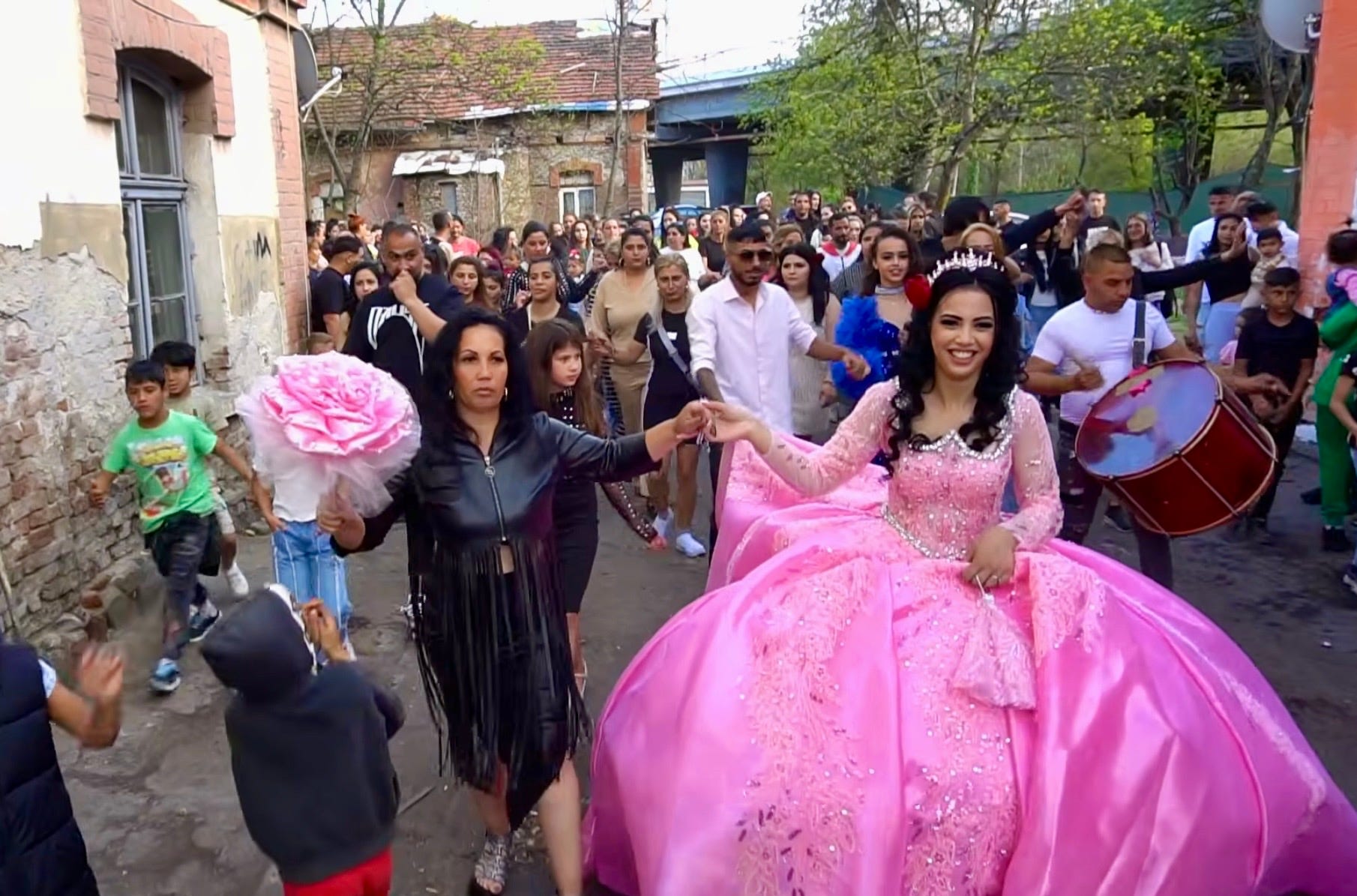
On the second day, after the first wedding night, the bride wears a pink dress. Pink symbolizes the drop of blood that alters the pristine white forever.
“In the white dress, the bride is an angelic icon. Marriage itself is an ideal, an image.
In the pink dress, she is a woman. The pink dress celebrates and recognizes the marriage between the bodies. In other words, marriage is not a theoretical concept anymore.”
From our piece “Why Roma brides change 3 wedding dresses”
While the immediate interpretation here is obviously sexual, for the Roma the symbolism of the pink dress goes much deeper than simply “consummating a marriage.” In Romani culture, casual sexual relationships are frowned upon and once a couple crosses this threshold, they are immediately referred to as “married.”
When people in Pepi’s tribe talk about past relationships, they say “I was married to her” or “I was married to him.” This does not mean they were legally married. It also does not mean that they had a wedding ceremony like the one Vessi had in the photos we’re sharing here. Weddings are expensive and not everyone can afford one.
So what makes two people “married” then? If there is no document, no ceremony, nothing and no one to declare them married?
Living together. Embodied reality. Falling asleep next to each other, waking up next to each other, figuring out what to eat together, sharing the big and small joys and struggles and sorrows of life.
In other words, walking side by side together. Facing life together. Not as a fantasy, but in real life.
“After all, it’s my shoulder you fall asleep on,” Pepi said once to Martina in a conversation we were having about a conflict Martina was experiencing. With this one simple statement, he communicated: I stand by you, I am your partner. The words he chose to communicate this, in typical Romani fashion, were of embodied intimacy, way beyond the sexual. Two people, joined together, in body and spirit both.
This is the symbolism of the pink dress. This is why the pink dress carries greater weight in a wedding than the pure, innocent, ethereal white dress.
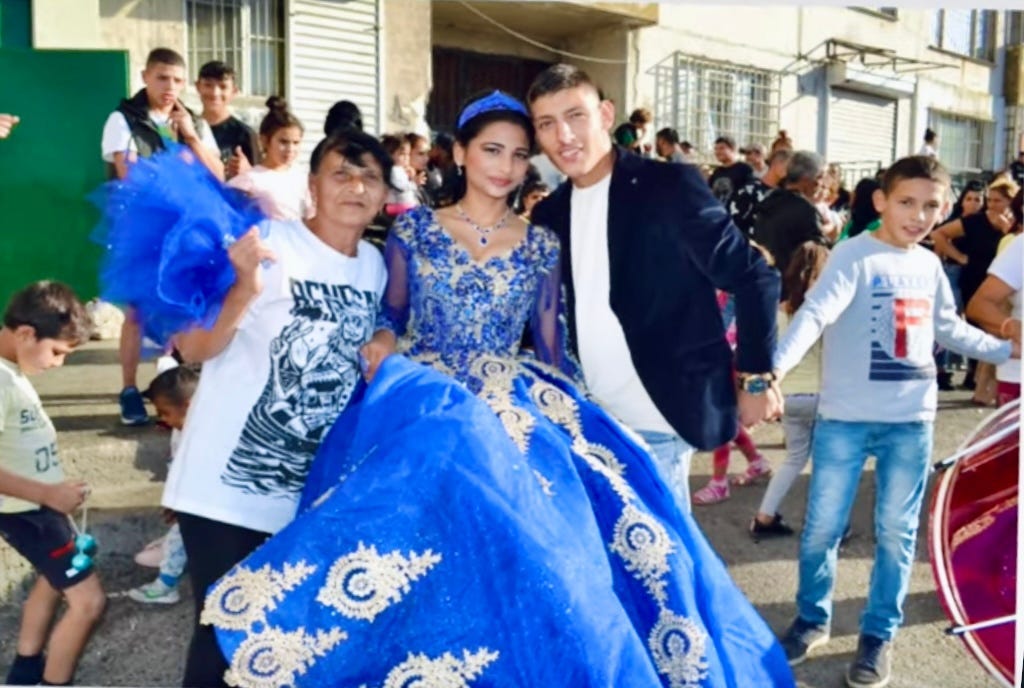
On the third and final day, Balkan Romani brides wear a blue gown.
You might have noticed that the pictures we share of weddings in Pepi’s tribe are all outdoors. Even weddings that take place that are celebrated indoors in a restaurant always, always begin outdoors.
Under the open sky. Hence, the blue dress.
On the final day, the Roma call upon the only authority, the only witness that truly matters. Not a government officiant, or a priest, or a human being in any kind of capacity.
God.
“The sky knows it and the earth knows it” is a common saying when a Roma shares a story about himself or herself. There is no “Believe me,” no overt effort to convince. The truth is always the truth, even if the person you share it with doesn’t believe it. It doesn’t matter because it was already witnessed by the sky and the earth.
The Roma don’t tend to get “legally” married. They have a natural and justified mistrust of institutions. Their weddings are not recognized as legally binding by society because nobody signs a piece of paper. They are also not recognized or respected as morally binding because, usually, there is nobody in an official capacity bestowing God’s blessing onto the bride and groom.
But in their communities, in their families, and most of all - in their minds and hearts, a couple is not married when the pure and innocent bride is taken by the hand. A couple is married through a series of transformations. A couple is married once the earth has witnessed it and once the sky has witnessed it.
From our piece “Why Roma brides change 3 wedding dresses”
The “modern” iteration of the Balkan Romani wedding tradition
Nowadays, there are no weddings that last three whole days, at least not in communities like Pepi’s, stricken by generational poverty.
A wedding that takes place one single day alone puts an enormous financial strain on the parents. It either plunges them in debt or it eats up all their savings.
However, this is an expense they are all too happy to carry. In fact, they believe that this is what they are supposed to work for: setting a strong foundation for the next generation.
This sentiment is beautiful depicted in the song “O davuli”, which translates to “Oh, drums”.

So, instead of changing three wedding dresses over three days, the Roma fit the changing of the gowns within a single day of celebration.
Some can afford three gowns. The ones who cannot make sure that they have one gown in one of the primary colors, but the bride will change out of it into a more modest dress later in the celebration.
In Pepi’s tribe, the vast majority of wedding dresses are blue. The Roma choose the color of the final day for the main celebration and all the photos, the color that calls upon God and announces: this couple is now married.
A smaller number of brides choose pink, like Vessi in the most recent wedding we showed you.
And so far, in the past decade, only one bride has chosen white.
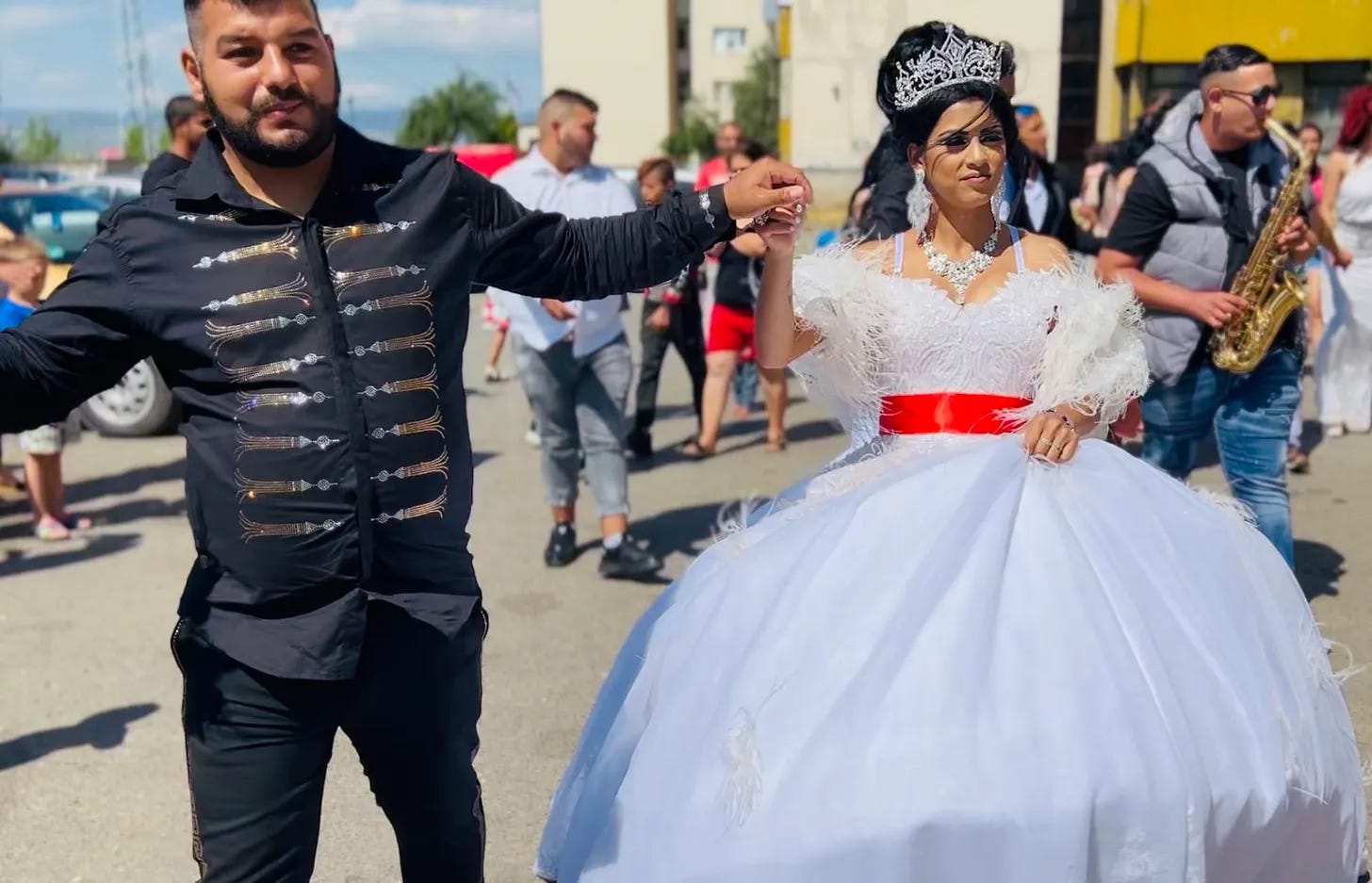
Julieta got married in a white gown. You’ll notice it was not pure white — it did not follow the Western style, but the Turkish tradition of adding a red belt around the waist: an echo of the Muslim roots of Pepi’s tribe, which the Bulgarian government forcibly Christianised in the 1970s and 80s.
Julieta wore the white gown for all the key rituals of the wedding: the “horo” dance with the tribe, the toasts, breaking of the bread, the blessings. Once this was all over, she changed into a blush pink satin robe adorned with a feathered trim.
Not a gown, not even a dress. But what mattered was that she transitioned from white to pink.
She announced: “I am now married, an embodied wife, not an innocent white flower to be plucked.”
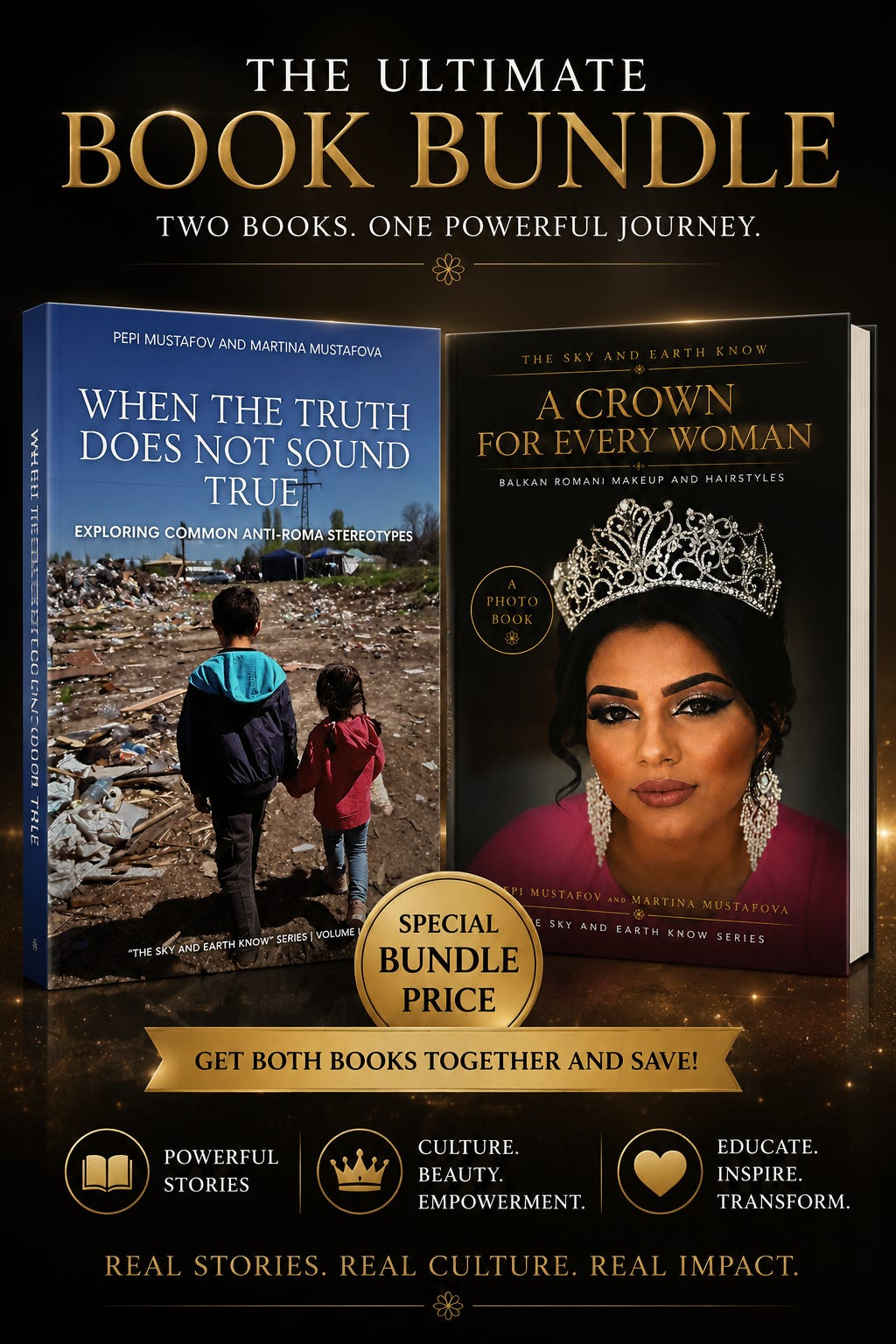
We recently published a digital photo book: “A Crown for Every Woman” with stunning pictures showing the traditional Balkan Romani hairstyle and makeup techniques. To celebrate this new book, we are offering it together in a bundle with our first book: “When the Truth Does Not Sound True: Exploring Common Anti-Roma Stereotypes”. You can buy the photo book or the bundle by clicking on the green button below.
To our paid subscribers, we are gifting the photo book entirely free: just scroll down below.
