


On May 16th, 1944 something extraordinary happened. An uprising at Auschwitz which sent the armed Nazi soldiers running away to safety.
On one hand, the uprising was successful. Nobody was killed in the gas chambers that night. And the order was for all 6,000 Roma and Sinti what they referred to as the “Gypsy Family section” to be “liquidated” in order to clear space for a new transport of prisoners.
On the other hand, the success was temporary —because the Nazis found another way to liquidate the Roma and Sinti prisoners. It took almost 3 months and a lot of manoeuvring until there were only children, sick, and elderly people left in the “Gypsy Family Section” for the Nazis to feel safe enough to complete their massacre. Though even then, the Roma and Sinti did not go out without a fight.
To know what is coming
On the evening of May 16th, over 50 armed SS soldiers arrived in lorries at the designated Romani section in Auschwitz-Birkenau, following orders to transport the 6,000+ people inside to the gas chambers. They ordered the prisoners out, but nobody stepped out.
The prisoners knew what awaited them. Some records indicate that earlier, they had been warned by a Polish clerk working at the camp. The order trickled down to the block leaders.
But even before that, they knew. Even if they didn’t know when, they knew what.
At some point in the spring of 1944, all Russian Roma were dragged out of the “Gypsy Family Camp” and the other Roma were told it was due to a smallpox infection. A quarantine, to protect the others from being infected.
“The evening it happened, a few trucks pulled up and the SS jumped out with dogs, rifles and machine guns. They set about herding the people onto the trucks. We heard screaming, barking and crashes, and peered out through the openings in the roof; there weren’t really any proper windows in the barracks. The vehicles drove off.
Before long we saw flames shooting up from the crematorium chimneys and the air was full of the smell of burning human flesh.”
Otto Rosenberg and Ulrich Enzensberger, A Gypsy in Auschwitz
On May 16th, this was the plan for the remaining Roma.
But this time, they knew.
Facing certain death
After months of living in horrific conditions, enduring starvation, disease, and forced labor, the Roma knew full well that the odds were not in their favour. They were malnourished prisoners about to face off armed soldiers.
But what else could they do? Just walk over to the gas chamber?
Never.
“Everyone thought, fine, if they want to take us out of here, then we’ll sell our lives as dearly as possible. We won’t just sit there for the taking.”
Otto Rosenberg and Ulrich Enzensberger, A Gypsy in Auschwitz
Here in the Sofia Romani communities, we see this exact same spirit when someone points a gun at a Roma. They don’t run, knowing full well you can’t outrun a bullet, they step forward with anger and fire. They face it, they are ready to fight. In this video we posted some time ago, you see a Roma man shouting “Come on! Shoot!” at a police officer who threatens him and his family with a gun.
Reading about the Roma’s reaction at Auschwitz when they learned they’ll be rounded up and “liquidated”, doesn’t surprise us at all. It is the only thing they could have done: resist.
The prisoners broke into an equipment warehouse and armed themselves with hammers, pickaxes and shovels. They took apart the wooden sections of the bunks they slept on and used the wood to make weapons. They took rocks, too. They went inside the barracks and barricaded themselves.
And then they waited.
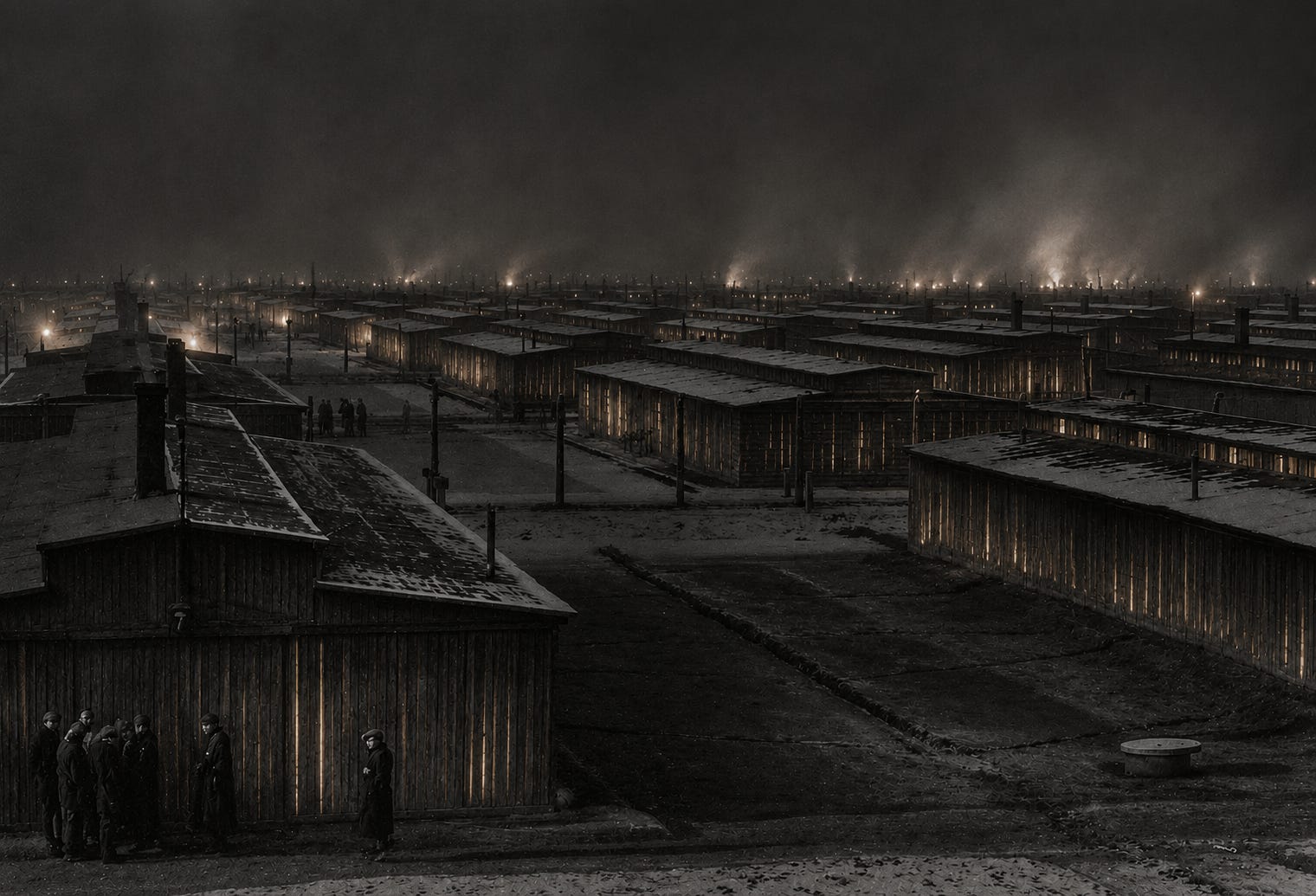
Lights at Auschwitz-Birkenau
In the evening of May 16th, 50+ SS soldiers arrived at the “Gypsy Family Camp” in trucks, armed with rifles and guns, and accompanied by German shepherds. They shouted orders at the Roma and Sinti prisoners — to get out.
Nobody stepped out.
The SS soldiers grew angry. SS-Obersturmführer Johann Schwarzhuber went from barrack to barrack and banged on the doors.
“Dad shouted out – the whole building trembled when he shouted: ‘We’re not coming out! You come in here! We’re waiting here! If you want something, you have to come inside!’”
Testimony of Romani Holocaust survivor Hugo Höllenreiner
It was clear that the Roma were resisting and all the other prisoners were witnessing it.
“Schwarzhuber noticed that the lights had gone on in all the barracks, even over in the Polish and Jewish camps. The whole of Birkenau was lit up. Everyone was on the alert.”
Otto Rosenberg and Ulrich Enzensberger, A Gypsy in Auschwitz
So what did the armed, trained, guarded-by-dogs Nazi soldiers do?
They turned around, got into their trucks, and drove off.
The Romani prisoners were ready for a fight. The SS soldiers were not.
The liquidation of the “Gypsy Camp”
The Nazis got what they wanted, eventually. On the evening of August 2, almost three months later, they arrived again in trucks, carrying guns and rifles, surrounded by German shepherds. This time, they succeeded in dragging the Roma to the gas chambers.
But why did they take almost 3 months?
Because first, they carefully picked out about 1,500 strong and able-bodied men and sent them to labor camps outside Auschwitz. Then they continued brutalising the remaining prisoners, sent children to Dr. Mengele for his experiments, and let people succumb to disease and starvation. On August 1, again, about 1,400 young men were picked out and transferred out to labor camps.
On August 2, there were less than half Roma at the “Gypsy Family Camp” than there were on May 16th. Less than 3,000. All of them women, children, elderly and sick people.
Safe enough for the SS soldiers.
Still, this time they were not 50 — they were a few hundred.
But even with all this preparation, the SS found no lambs to drag to the slaughterhouse.
“Uniforms began to swarm in the Gypsy camp. A few hundred of them must have come. A line of lorries is coming. We hear the scream: “Raus! Raus!” The Gypsy barrack in front of our block is closed. The SS men are trying to open it but the door must be locked from the inside. They are beating rotten boards with crowbars. They are coming inside as one body.
We hear screams, shots, but nobody is leaving. One more group of SS men is intruding the barrack. After a while we see them drag out two young Gypsy girls screaming piercingly. Others are attacking the torturers, scratching their faces. They are defending themselves with gunstocks. The SS men are dragging kids’ legs and an elderly man is trying to defend them but one kick is enough to disable him and take him to the lorry. No one leaves the barrack without resistance. Everyone is fighting.
We hear the SS men screaming and the Gypsies shouting. Women are the fiercest in their fight — they are younger and stronger — protecting their children. The fight lasted until dusk and it seems that everyone dragged to the lorries expressed some resistance.
This is how the remaining Gypsies were murdered, in a number from three to four thousand. On that same night, our camp was covered with some, black as tar.”
Account by former Auschwitz prisoner Alfred Fiderkiewicz
May 16th is commemorated as Romani resistance day, marking the first, the successful uprising.
August 2nd is commemorated as Romani Holocaust Remembrance Day, because this is when the “Gypsy Camp” was finally, to use the Nazi term, “liquidated.”
But August 2nd was also Resistance Day. The Roma were fewer and weaker than on May 16th. But they still barricaded themselves. They still fought back. They still gave the Nazis hell and made them struggle and fight the entire night.
So on both May 16th and August 2nd, let’s remember the Romani fire which made “the whole of Birkenau light up” even in the face of cruel, genocidal death.