


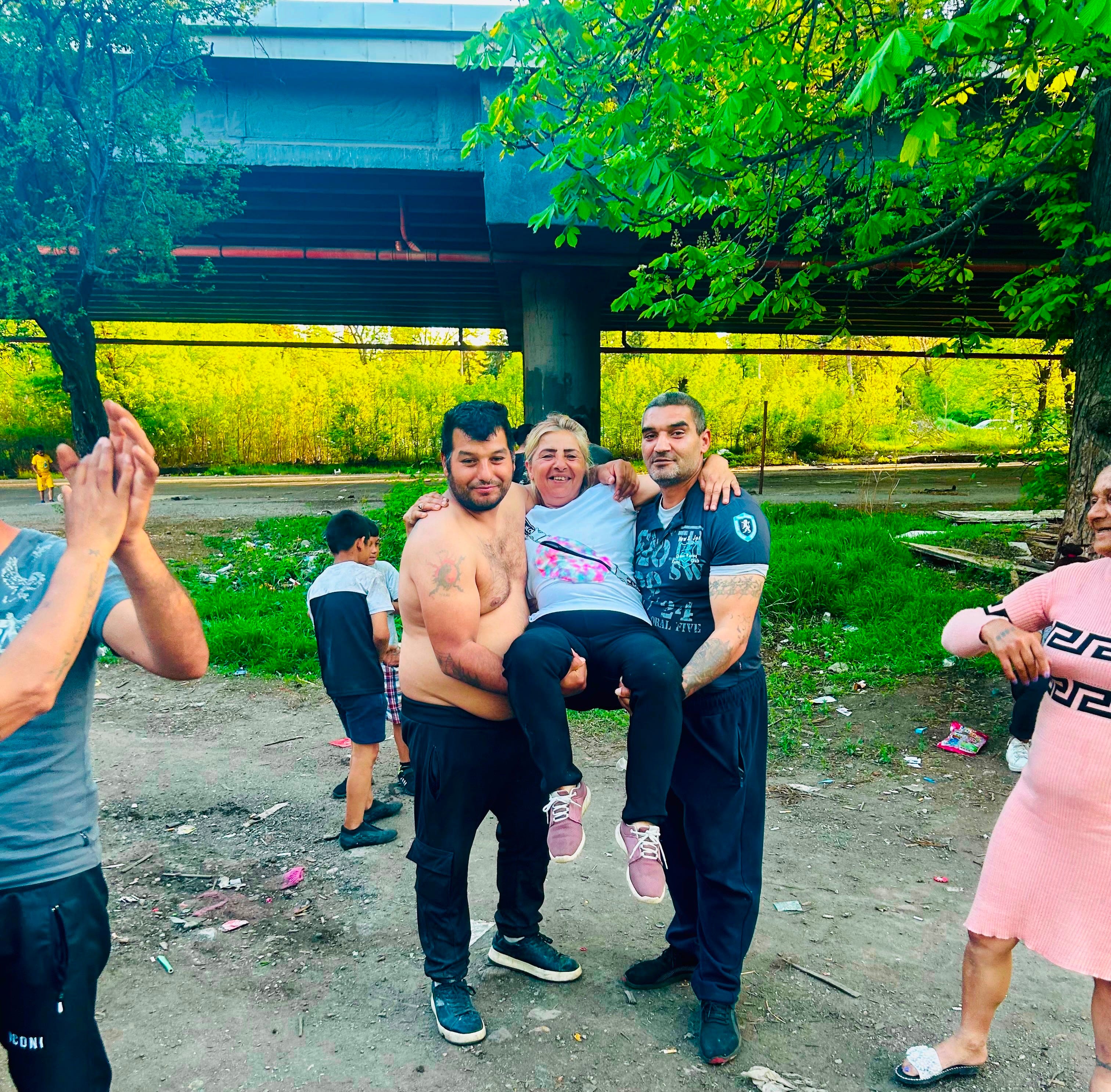
The title image of this article depicts Dana in the arms of her youngest brother (and co-author of this blog) Pepi Mustafov and one of her nephews, Little Pepi. In the previous two articles of our series on the topic of betrayal and forgiveness, we told you how Dana was the one who gave up Pepi in an orphanage when he was 6 months old, dooming him to a life as an orphan until he rediscovered his roots at age 16; and how Dana stoked the fire of a conflict between her adult children and her sister Nana’s adult children, which resulted in a mass fight. Little Pepi was beaten with rocks, alongside his eldest son, his sister Vela, and her husband Nicky.
Is Dana forgiven?
When you look at this picture taken years after all these events, it’s easy to say “yes”.
And that’s the point. The “yes” should be easy.
The relationship should be unshakable. Indestructible. Even when one abandons the other as a baby. Even when one attacks the other with rocks.
Even if there is no real forgiveness. Even if the threat of another conflict looms in the air.
It all comes second to one unspoken law: Above all else, the Roma stick together. If not in heart, then in appearance. Very convincing appearance.
“It’s a posture, a show of strength.”
This is how Pepi describes the title image of this article as well as all other examples we listed out in our previous articles describing Dana’s relationship with Nana’s kin after the big fight. Hugs, kisses, dancing, preparing the food, helping with each and every celebration, small or big: Dana and Nana are, on the surface, a picturesque example of a strong sisterly bond.


Martina was fooled. For the almost four years we have been together and Martina has gotten to know Pepi’s tribe, in countless gatherings, chats, jokes, weddings and birthdays, there has never been the slightest inkling of animosity between the two sisters.
But Pepi is adamant, the fight is not forgiven.
“And all this warmth, all these celebrations, all this help and cooking and support?” Martina asked.
“It’s for the people,” Pepi says. For other people’s eyes.
It’s not from love in the immediate, conventional sense. It’s a show. The two sisters, who are matriarchs in their own family systems and elders in the wider tribe, are both setting aside their pain to send a strong message.
Namely, an unsentimental “We are one.”
And the message lands loud and clear in its intended audience: outsiders as well as people in the tribe.
After the 2021 fight, the district mayor and the initiative committee which has been campaigning for years to remove the Roma from the neighborhood all jumped at the opportunity to use the fight as argument to justify their ethnic cleansing efforts. The mayor was on his way to displace 30+ Romani families and when Martina (then part of a non-profit group, not yet together with Pepi) was trying to argue with him on the steps of the municipality, he looked her in the eyes, paused, and said “Did you hear about the fight?” as if that was the ultimate check-mate.
For racist outsiders, the fight was a gold mine. The logic being, “the Roma are so savage, they pummel each other with rocks, so of course we as the civilized ones should get rid of them.”
The Roma understand this perfectly, of course. And it only reiterates their belief that outsiders meddle in their internal affairs with hostile intentions and should be kept out at all costs.
In our article about mass fights we spoke about the Roma having an entire system of distributing justice that remains strictly internal, and outsiders are never given the whole story or any meaningful detail. Even if the outsiders are well-meaning. Even if they are speaking to a mother whose child was just killed, or a widow who just lost her husband.
The racists of the Zaharna Fabrika neighborhood, where Pepi’s tribe is located, find themselves complaining about a mass fight with rocks one day, and complaining about large celebrations another day. The cognitive dissonance is powerful, and very much underestimated by the municipality, the initiative committee, and anyone else campaigning against the Roma.
“We will never get rid of them,” lamented a white middle-aged woman buying coffee one time, overheard by Martina standing in line behind her at a coffee shop in Zaharna Fabrika. “The mayor promised, but he’s useless. We will just never get rid of them.”
To a novice observer it appears that the communities in Romani ghettos don’t recognize the code of mainstream society, the customs, the social obligations. In reality, they recognize all these elements very well. They understand them very well. They also know that outsiders are looking to fracture their community. They know the ultimate goal is to scatter and erase their families.
So no matter what happens inside the tribe, what outsiders see will be overwhelmingly weddings, love, loud music, birthdays, big families with children. And in the (rare) case of a conflict brewing over the edges and escalating in a mass fight, then the love, music, and celebrations become louder.
It’s hard to point at the picture of Pepi and his nephew holding up Dana in an embrace during a birthday party and say “They are savages, they attack each other with rocks, we need to get rid of them.” Of course, racists still do it. But while the racists are playing with the classic tools of stereotyping and institutional violence, the Roma are playing on a completely different field: psychology, roots, and a radical form of unitedness.
So to outsiders, the Roma are elusive, untouchable, somehow always evading and escaping the traps set out for them. To outsiders, they are “hard to get rid of.” Demolish their homes, inflict violent police raids, take their basic documentation, block their access to education or dignified work—try anything you can think of to crush them. The next day, you will again be hearing loud music.
The real message, however, is not for the outsiders
Non-Roma get a very tiny glimpse into the Romani life, even the loud celebrations that are meant to be seen and heard. But the unity that is on show even in cases of unforgivable hurts is constant. Outsiders see only a shimmer. The tribe and all its members are the ones who witness it every day.
In our previous articles from this series, we described how Dana is quietly preparing food for birthdays, cooking traditional meals for weddings, helping with the collection of birthday gifts, and stopping by daily to catch up with her sister Nana and her kin (even on her way back from the hospital after an injury).
On the surface, there is not a single ripple of discontent between the two sisters. On the contrary, they appear bonded and supportive of each other.
“There has been no forgiveness,” Pepi explains, “But they act this way to set the tone.”
Dana and Nana, now elders in the tribe and matriarchs of their own respective circles, are wordlessly showing to their children and grandchildren that, despite everything, they should all stay united.
They are also signaling to everyone else in the tribe that they are in control of the conflict and relationship with each other.
So is it all fake? All the warmth, help, and support? The hugs, and dancing, and laughter?
If you ask Pepi, he’ll say yes. It’s fake. It’s for show. It’s done with an agenda. To him, if it doesn’t come spontaneously from the heart, then it is not real.
But what does come spontaneously from the heart here is something else. Preserving the tribe at all cost. Preserving the wider collective despite any individual quarrel. Staying united even when there are cracks.
Forgiveness here means survival of the tribe because without the tribe, the individuals have nothing else left. For the Roma, the world outside the tribe is a moonscape. Hostile to life, without oxygen.
“Real forgiveness is quiet.”
“What would a true forgiveness between Dana and Nana look like?” Martina asked after having witnessed nothing but sisterly love between them for four years.
“A formal visit,” Pepi said, “One of them would take her children and visit the other and her children, and ask forgiveness. Then forgiveness will be given quietly and calmly. A simple “I forgive you,” like it is done in the Vasilitza ritual. Then the children—the cousins who participated in the fight—will follow suit.”
To Pepi, the first marker that something is far from forgiven is a loud and public declaration of love.
“When I see someone gesticulating with their hands, waving and saying “I love my cousin”, “I would die for my sister,” then all I see is the energy of one person wanting to slap the other person. In my tribe, forgiveness is asked for and given very quietly. Calmly. Everything else is a performance.”
The 2021 fight between Nana and Dana’s children remains now one of these festering wounds that are bound to inflame. Grudges, like we said in our earlier articles, are never really old in Romani culture. They ignite with the same intensity as if the insult happened yesterday, not years ago.
“So nothing is ever resolved?” Martina asked. “At any point, things might explode, new pain will get inflicted, and the cycle continues?”
“Yes,” Pepi said, “Sometimes even children or grandchildren carry out unresolved anger many years later without fully knowing why.”
Anyone familiar with Jungian psychology would be nodding their head at these words. In Jungian theory, nothing disappears until it is fully acknowledged, worked through, integrated. If you bury something in your psyche, it only becomes more and more intense until it rushes back to the surface and overpowers you.
For the Romani communities living in poverty and isolation, this is lived reality. Acknowledging, working through, and integrating interpersonal wounds is a luxury when your physical survival and that of your children is linked entirely to the tribe around you.
The love is real. But it is very complicated. Pepi’s Romani relatives hold both extremes as equally true: I love this person and I hate this person. I want to hug this person and I want to hit this person. They know that one does not exclude the other.
This gives them rare psychological depth, especially compared to mainstream culture which is comfortable in two-dimensional labels and easily digestible emotions. Not to mention the collective pressure to “stay positive.” All of that introduces its own form of neurosis, which the Roma will never suffer from because they are comfortable in the depths, not in shallow water.
However, the protective web of the tribe can also serve as a prison, a wall that surrounds everyone so energy has nowhere to go and collapses upon itself. Conflicts are very intense. It sometimes might feel that conflicts are eternal, and just lay dormant for a while, then explode into a fight, and become dormant again until the next explosion.
But more often, it feels like the tribe is so united, so indestructible, that neither tremors outside nor tremors inside can shake it.
It took a while for Martina to wrap her head around the concept of forgiveness in Pepi’s tribe. It is not black and white and it is beyond the interpersonal. It might look like anything can transpire between two people, and still, they will hold strong as a family.
Is anything, anything at all, unforgivable?
To Martina, it eventually occurred that there was only one way to answer this question.
