


Mainstream culture believes the Roma are too extravagant. When they decide to dress up, they really bring it.
Bright colors. Dresses that look like princess gowns. Glitter. Gold. Heavy jewelry, heavy make-up. Elaborate hairstyles and tiaras.
Here is one example. The picture below is from Vela and Nicky’s wedding. Vela is in the cream dress, Nicky: in the black glittery suit and neon sunglasses. Vela’s sister, Dancha, and her husband Trayan, are the maid of honor and best man, and they are dressed up in bright red. Vela and Nicky’s son, toasting to their champagne with an energy drink, is also wearing a suit.
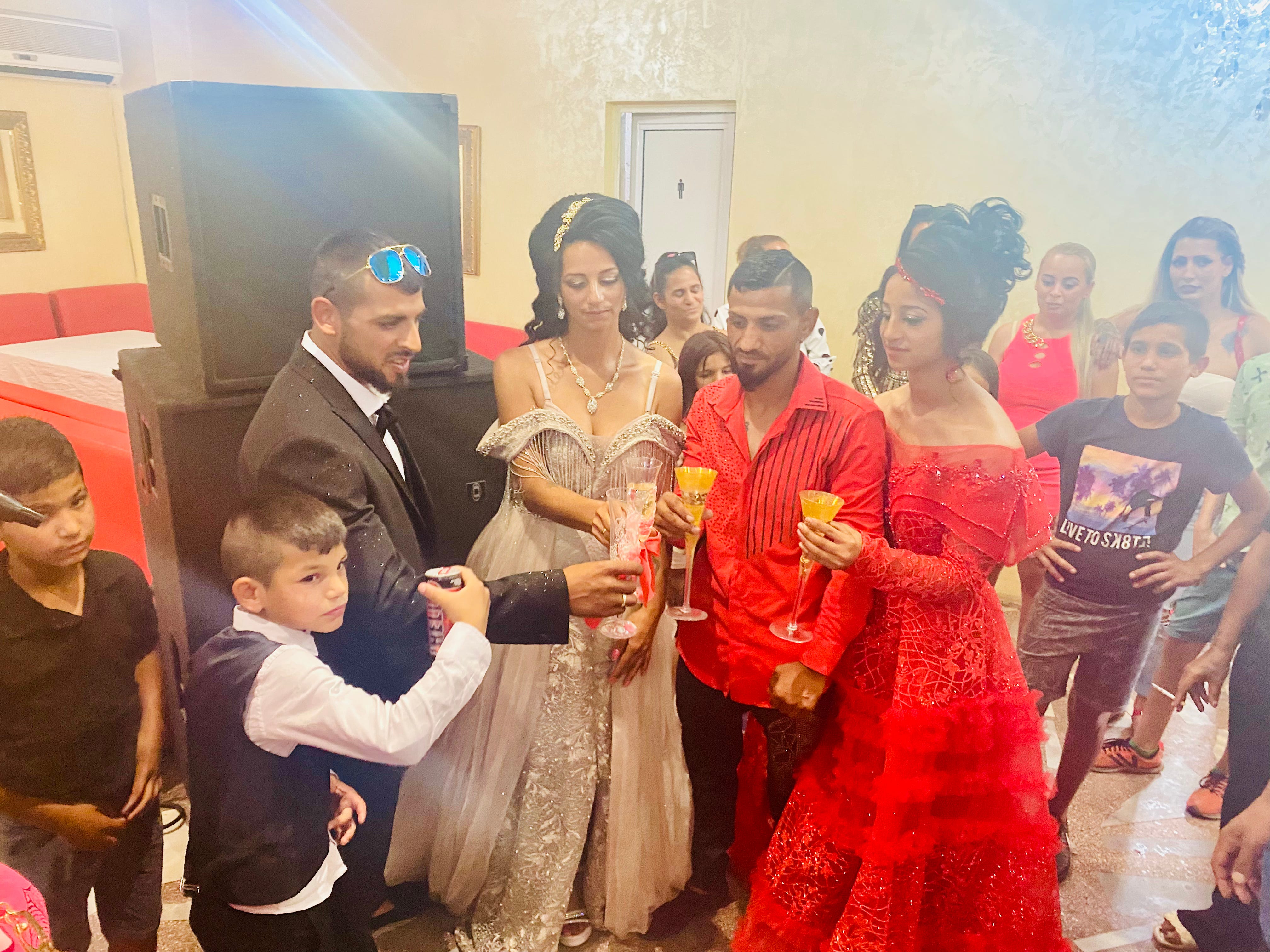
But let us show you a couple of more pictures: from Dancha and Trayan’s wedding 3 years earlier.
Dancha is dressed like a goddess. The groom, Trayan, is in jeans and a yellow t-shirt with a printed skull. Nicky is in mismatching shorts and t-shirt, with a cowboy hat. Pepi, Dancha’s uncle and co-author of this article, is in a camouflage outfit.


And if you’re about to assume that “rules are more relaxed for men,” here are two more pictures. In them, you can see Nada joining the wedding procession and dancing, still in her work clothes from her street-cleaning job.


So, what is the dress code for Romani celebrations?
Nobody cares what you wear
In mainstream societies, there is an entire culture around dress codes and what is appropriate to wear for specific occasions. It’s a fascinating study in psychology to browse relationship forums (on Reddit, for example) and see how many friendships and familial ties break over who wore what to where.
Your clothes and general appearance determine how you’re received by your peers. If something is a little off, like messy hair or an out-of-date style, this is a flaw. You will be judged. In mainstream culture, that is.
In Romani culture, nobody cares. You can show up wearing a golden ring on every finger, a tiara, a gown, or a neon-glittery outfit. Or you can show up with an old t-shirt, a rip in your jacket, holes in your shoes, tangled hair.
It doesn’t matter.
The Roma only care that you are there. You. The fabric on your skin bears no importance.
The “rules” and social norms we take for granted in mainstream society when it comes to celebrations and big events start looking very restrictive and even a little petty if we compare them to how the Roma approach celebrations.
In Romani culture, there is no concept of “stealing one’s thunder.” The Roma enthusiastically join celebrations together, and it is, in fact, a custom to hold weddings on a beloved relative’s birthday.

The Roma are not offended by what you wear. They neither feel slighted if you’re underdressed nor outshined if you’re overdressed. They don’t have rules about what clothes suit what age and what figure. They are not offended by what gift you bring or if you bring a gift at all. They are not offended if you announce big news from your life on someone else’s “day” or “event.”
The only thing that will offend them is if you don’t show up.
Your presence and nothing else is what signals to them that you love and respect them.
So why dress up at all?
Well, why not? If you feel like it and you can afford it in this moment, why not have fun?
Here’s a secret wisdom that the Roma have held for over a thousand years. The lack of attachment to material things and to symbols of status or prestige allows you to enjoy them more.
The Roma enjoy wearing golden jewlery but they don’t think twice about pawning it if they need cash. They swap clothes with each other all the time. There is not a shred of possessiveness in their bones about “things.” So they are free of all the anxiety that comes from attachment. They’re only left with the joy of using these “things” in the present moment.
The pictures below are from a wedding that took place in the summer of 2023. You can see Pepi and his sister Nana, who’s wearing the same dress her daughter Dancha wore when she was maid of honor the previous summer. And you see Pepi rocking a suit-jacket “for the laughs”, borrowed from the father of the bride, to take this picture with his eldest daughter.


We recently published a digital photo book: “A Crown for Every Woman” with stunning pictures showing the traditional Balkan Romani hairstyle and makeup techniques. To celebrate this new book, we are offering it together in a bundle with our first book: “When the Truth Does Not Sound True: Exploring Common Anti-Roma Stereotypes”. You can buy the photo book or the bundle by clicking on the green button below.

What about the wedding dress?
At a Romani wedding, everyone can show up in rags but the bride. The bride will always, always be dressed up.
But this has nothing to do with vanity or appearances.
