


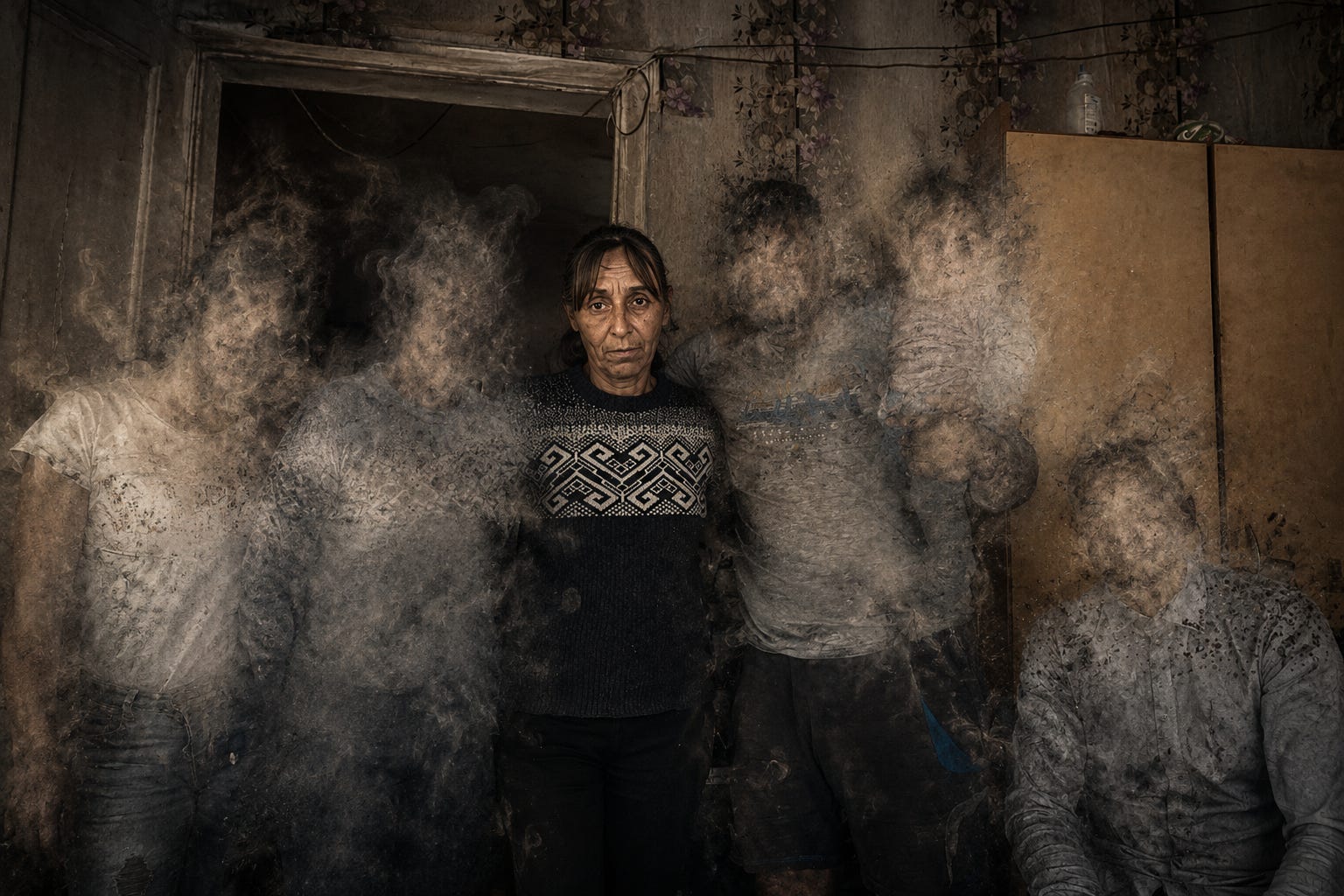
All who made me cry, sings Džansever Dalipova in her song Sar ka dav akaja rat me vilestar me,
may their fortune leave them,
may their eyes not see,
may their hands not hold.
Oh God, hear my curse
and pour it on them.
Do not give them life.
If you think this is intense, wait for the chorus of the song.
May fire burn them,
and turn them into dust.
May the wind scatter them,
and cover them with earth.
The protagonist in the song is a pregnant woman who, if you read between the lines and into the implications of the lyrics, was abused by her husband and his parents. “They”, in the song, are her husband and in-laws, the people who wronged her and repeatedly hurt her.
In her actions, she is not vengeful. The song implies she leaves forever, and they will suffer in her absence. But in her words, thoughts, and heart, she calls upon divine justice, upon God to balance the scales.
“God will take care of it,” a young woman from Pepi’s Romani community said recently after a conflict escalated and she felt wronged. “My tears will fall upon them.”
What she meant was, all the tears she cried will, through divine justice, be returned in the form of equal suffering to the people who wronged her.
In an article from a few years ago, we mentioned how one of the more timid women in the community was pushed past her breaking point when an elder man gifted a dog to her young daughter, and then soon after, took the dog back.
“She keeps crawling under the bed several times a day,” Yoanna told Martina about her daughter, “looking for the dog because it used to sleep there.”
Seeing her daughter’s heartbreak was what broke Yoanna’s silence. One day, when she was sitting by the sidewalk watching the children play, the wife of the elder man walked by. Yoanna heard herself speaking and her voice carried strongly around her. Her words, in typical Romani fashion, were intense and came from the depths of her soul.
“Just as my daughter is crying for that dog, may you cry over your husband’s grave.”
This stopped the woman in her tracks.
“She just stared,” Yoanna relayed to Martina later. “She couldn’t say a word.”
A few months after we published this article, the elder man did in fact pass away. And while neither we nor the wider community believe it was Yoanna’s words that caused his death, the implicit understanding here is that the suffering he caused through his cruelty to a small child compounds the grief of his loved ones. The child’s tears are added to their tears. Their pain, already heavy, becomes even heavier. What stopped his wife in her tracks was exactly this sentiment: he crossed a big boundary, needlessly broke the heart of a child, and now the mother’s wrath invoked divine justice. So the pain will find its way back.
Do these curses carry actual power?
“A Romani blessing always comes true,” says Pepi, as does anyone from his community if you ask them. The thing is, Romani blessings are not given lightly. For a Roma to bless you with their heart, it has to be earned and it has to come from their soul, which is why it carries power. It cannot be forced, so even if someone blesses you in words, these words carry no power if the soul is not behind them.
Same goes for a Romani prayer.
One time, while working abroad in what turned out to be a scam summer berry-picking gig, a group of men from the tribe got lost. They were stranded in a remote location, tried to walk back to the nearby village, but lost their way. This was in a Scandinavian country, they did not know the language, could not read any signs, and there was no one around to ask, even if they found a way to ask through the language barrier. Left without any other possible course of action, they gathered in a circle and did a “Romani prayer.” Which is exactly like any prayer, as long as it is pure, comes from the soul, and above all, with unwavering faith in God. Soon, a guy in a small truck passed them by, stopped, and gave them a ride to a village nearby. From there, they found the police station who connected them with the embassy and soon they were on their way home. Did the prayer bring the truck? They believe it did.
What is important to understand about this and most Balkan Romani communities is that they encounter vastly bigger challenges than people from mainstream society, and they encounter them more frequently. Due to generational poverty and racism, the obstacles in their life are constant and relentless. And they don’t try to pray their way out of those. They face them, they hustle, they try to outmanoeuvre, or climb out, or fight. A prayer, a “Romani prayer,” which means that you stop, you connect with your soul, you connect with God—this comes when there is literally no visible way out, no hope. When only God can help.
They believe it works, because they know they have already exhausted all options conceivable to a human.
Just as a Romani blessing carries power when it comes from the soul, and when a Romani prayer carries power when it comes from the soul, a Romani curse can carry power too.
Of course, the same caveat applies. A curse is true only if the balance of scales in the human realm has been profoundly disrupted. So only God can restore the balance. A curse can sound very cruel, but in its essence, it invokes justice, karmic balance. It comes only after a deep wound has been inflicted, and that is usually a wound that cannot be healed.
Soon after part of the quarter (or mahala) where Pepi’s community had lived for a century was demolished, the mother of the district mayor who oversaw the demolition passed away.
The people in the community believe this was his natural punishment from God. Losing his mother after he destroyed their homes. The Roma believe firmly in divine justice. Human justice is something they mistrust, as well as human-designed concepts of justice. For example, even though many Romani communities live in poverty, they don’t believe a restoration of divine justice would be an economic rebalancing. Justice, to the Roma, is what touches the heart: your children, your wife or husband, your parents and siblings. This is why the loss of a mother, in the eyes of Pepi’s community, equals the destruction of the homes of 60+ families. And the community believes that divine justice always finds its way.
A curse is, in essence, an invocation of this type of “natural law.” Urging God to restore balance. A recognition of one’s own pain and surrendering it to the sky.
So do Romani curses carry actual power? The Roma believe that even without the curse, if you profoundly wronged another person, the pain will return to you. A curse might speed this up, intensify it, make you feel the unmistakable correlation, make you regret your actions, but it will only work if you already wounded another’s soul.
A QUICK NOTE BEFORE THE ARTICLE CONTINUES
Džansever Dalipova, recognized as the Queen of Romani music here in the Balkans, passed away in August 2026. This month, in her honor and memory, we are dedicating each of our pieces to songs, in which she explored the true, unfiltered life of her fellow Roma. Queen Džansever’s songs are all full of soul and raw truth. In our pieces, we will aspire to do her songs justice.
You can listen to the song that inspired this piece, along with its English translation, below.
The small, “everyday” curses in Romani life
The song that inspired this piece depicts what is, essentially, sacred rage. Anger that comes from deep, accumulated pain. These curses, the Balkan Roma believe, carry power.
But then there are other, “smaller” curses in Balkan Romani culture, which are used to let off steam, in the heat of conflict, but are understood to not carry weight.
“May fire burn your head,” is the most frequent one in Pepi’s community, sometimes with the added, “and melt you.”
In our Balkan context, it is a real eye-opener to see how the Roma treat, see, and talk about their mothers.
In all Balkan and Eastern European countries, swearing always involves the mother.
We don’t say “F off.” We say “F your mother.”
When we want to say something bad happened, we say “It F’d its mother.”
When we want to say that something bad happened to us, we say “It F’d my mother.”
The list goes on, but you get the gist.
The Roma never, ever involve anyone’s mother when they swear. And they do get angry, they don’t avoid conflict, and they do get very fiery with their language. But where most Bulgarians would say “F your mother,” a Roma would say the much more creative “May fire burn your head.” Sometimes they’ll add, “and melt you.”
There is an area where the Roma mention the mother with the same frequency as Balkan people mention her in swearing.
Songs.
The “May fire burn your head” curse gets tossed around daily in Pepi’s community. If conflicts get intense, the curses become very intense too. “May the truck drag you down the street,” one of the elderly women said to one of her brothers once, after he had gotten in conflict with her son. The truck in question was the garbage truck where her brother worked as part of the street cleaning job the entire community works in. She essentially wished upon him not only to get hit by the truck he rides on daily, but to be dragged by it down the busy boulevard in the neighbourhood.
This was understood both by him and by the wider community to be a “in the heat of the moment” curse. They didn’t take it seriously, they allowed time for the emotions to naturally calm down. Eventually, it was all forgotten and he was not hit by the truck. Nobody believed she actually wanted harm to come to her brother. In her anger, she reached for the most damaging image she could think of, but the curse carried no power.
Another “everyday” curse, which would definitely be the most jarring to outsiders, is the unthinkable:
