


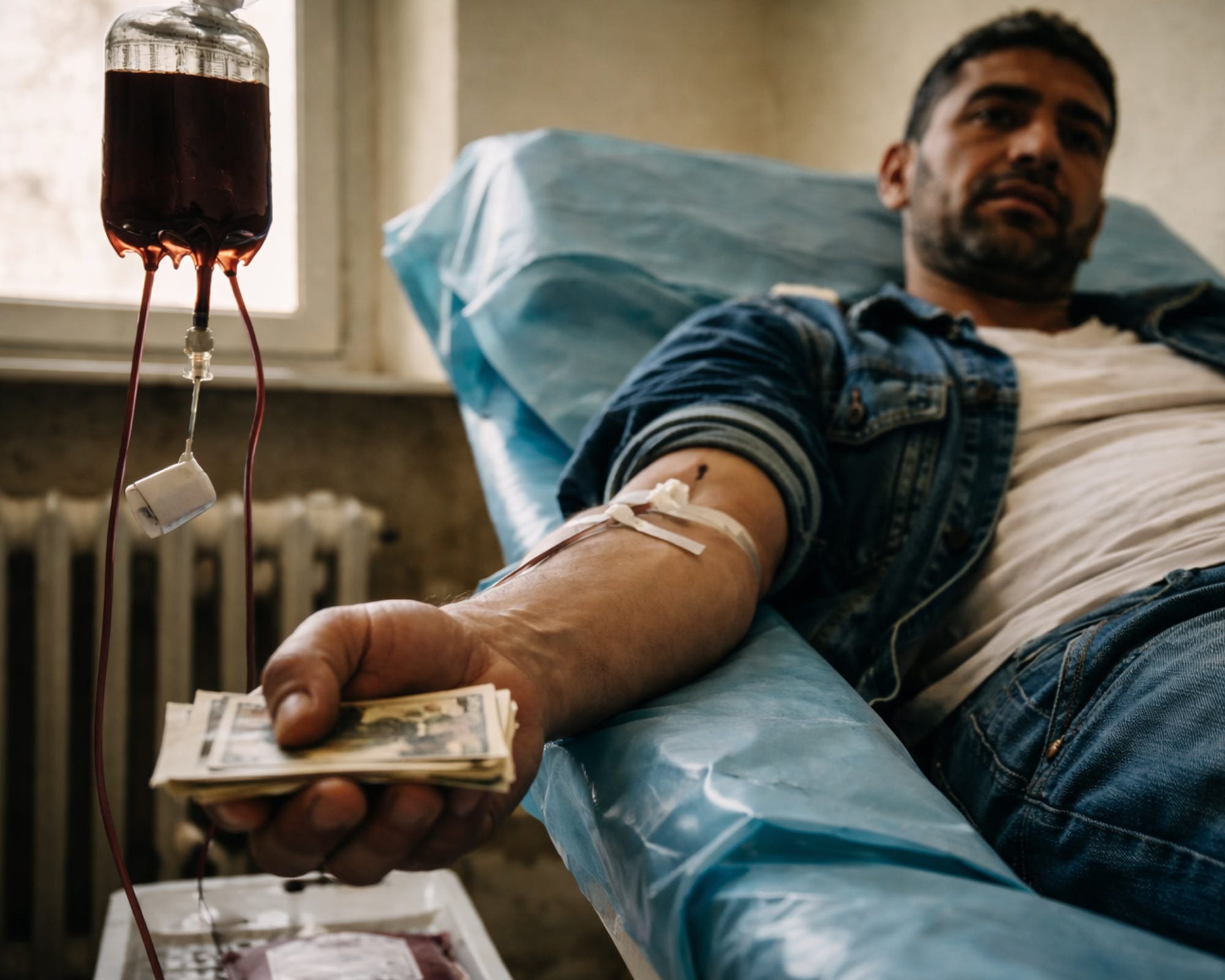
“Brazen Gypsies Run a Vile Scheme With the Lives of Sick Bulgarians” reads the title of a 2019 article in a random media site. Other more established sites and media outlets use softer language but communicate the same kind of outrage. Namely, how dare they? How dare they ask for money when you are running in panic over a sick loved one?
Here in Bulgaria, when someone needs surgery, regardless of whether planned or emergency surgery, blood needs to be donated and registered under their name so that the hospital can maintain its blood bank quotas. Blood is scarce here. There is no culture of donating blood and our healthcare system has no money to import from abroad. So when someone is in for surgery, their relatives are on an urgent mission to find blood donors and, usually, they come up short. “During socialism,” one of the articles says, “it was almost like a national sport to donate every few months.” But now, nobody steps forward.
Except for the “brazen Gypsies.”
When you go to the center for transfusion, all articles say, you see them out front, walking around. They approach you and ask if you need blood.
So far, so good.
But then, you learn, they don’t just wait around all day and offer blood out of the goodness of their heart.
The blood has a price, in cold cash.
Is it a mafia?
“The blood mafia,” as some articles call it, does have several mafia elements. The actual blood donors are Roma living in poverty. They get paid between 25 and 50 EUR for a donation, when the “clients” are charged between 150 and 300 EUR, or even up to 500 EUR for rare blood types. The difference goes to the groups running this scheme and scouting for buyers.
But it is not pure profit. Big sums go to bribing the police to look the other way. This, though, is not reported in any of the articles. The reason we know it is because Pepi has been one of those people donating blood for 25 EUR, as have many, many other people in his community. And the groups running the whole “gig” are from a neighboring tribe.
Of course, they discourage individuals from offering their blood. It has to go through them. When we say “discourage”, this can mean many things. One article about a remote Northern location in Bulgaria says that a similar Roma group beats up other Roma who donate blood for cash outside of their channels. “Breaking both legs is the least they do,” the article says. We don’t know how true that is. Here, in Sofia, you get threats for banishment. “If you try this,” they say, “we will never contact you again and hook you up with clients.”
With social media, this threat doesn’t carry as much weight anymore because many people here use large designated Facebook groups to ask for blood donors, and a lot of Roma respond to these posts, cutting out the middle man.
And of course, they don’t ask for 25 EUR. They ask for 250 EUR.
Is it extortion?
“Blood traders extort people in need,” cries the title of another article.
Let’s meditate on this word for a bit. Extortion.
Here is what the Merriam-Webster dictionary has to say about it.
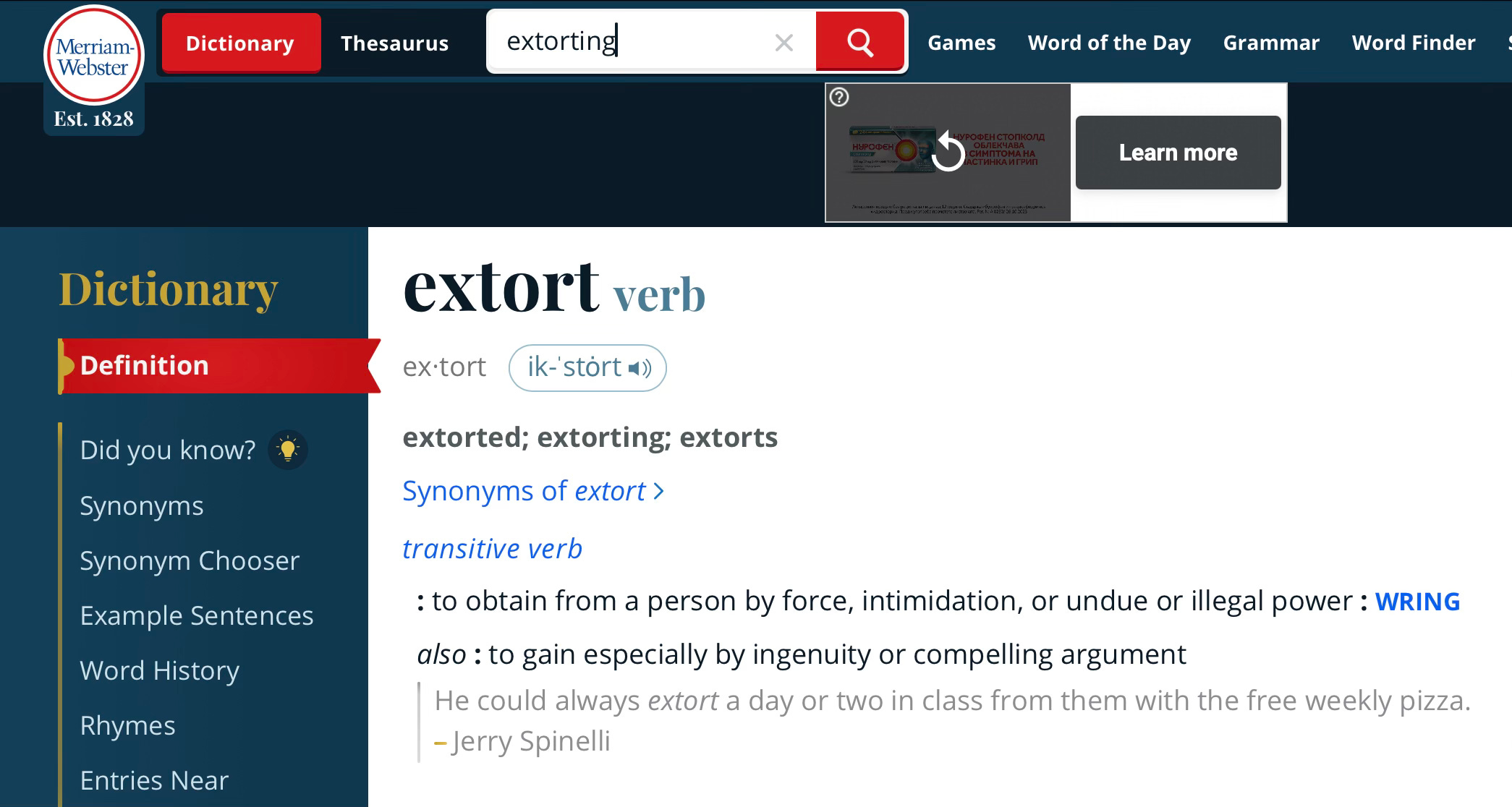
Do the Roma obtain the money by force? No.
Do they obtain it with intimidation? No again.
With undue or illegal power? Again, no. Unless we consider having blood to be power, and even then, it would not be undue or illegal.
What about gaining with ingenuity and compelling argument?
Well, bingo.
Their argument is compelling.
The blood banks are low. The healthcare system is malfunctioning. For decades, the governments in power have had no budget or strategy about blood needed for surgeries.
And when people need blood, when they start calling friends and family, when they reach out on social media, nobody steps up.
“But they [the Roma] are not the only ones who offer blood in exchange for payment,” says an anonymous nurse in the extortion article. “Very often the blood is repaid with cash or some other service, even between relatives”.
So your own kin might ask you for money. But the author of the article, even after this quote, focuses on the Roma being the extorters.
The government fails you. Your community fails you. Your family fails you.
But a Roma living in poverty is expected to rise above it all? Make it alright? Be charitable to middle-class strangers in a racist culture, when their own children are starving at home? Literally bleed, in order to balance out a broken system and a broken society?
The Roma offer. They don’t pressure. They recognize that most people probably have nowhere else to look but they did not create the society that developed this lack.
Who gets to decide what a human body is worth, and under what conditions refusing to give it away for free becomes a crime of character?
“Better to bleed than to steal”
For the person looking for blood donors, the situation is obviously about survival. So when a Roma person asks for money, they appear as a predator preying on the vulnerable.
“My mother needs urgent surgery, and you’re asking for money?”
It feels like extortion, regardless of whether it technically is or isn’t.
But for the Roma person, this is also about survival.
The Roma person’s mother might need medication. They may be out of food. A baby at home might need formula and diapers.
Pepi donated blood for 40 EUR in February 2022, when Martina was less than 2 months pregnant and with lapsed health insurance after having been out of a job for several months. It was a rough time for us and we had run out of cash when Martina started having severe pain. Without the health insurance, going to the doctor would require cash. So Pepi went out for a couple of hours and came back with 40 EUR, enough to cover a checkup. For Martina, new to these nuances of Romani life, this felt both dystopian and incredibly resourceful.
Pepi doesn’t know who he donated the blood for because it was through the organized group that handles the clients and keeps the bulk of the money. And the person who received the blood does not know that the person who gave it had to do it so he can take his pregnant wife to the doctor.
“I feel it’s hypocritical of people to get so upset when a Roma asks for money in exchange for blood,” Martina said to Pepi, “when there is so little regard for Romani lives in our society. They don’t value the Roma’s life and health but expect the Roma to still be generous to them with their own blood.”
“I agree,” Pepi said, “but that’s not why we ask for money. We do it because we feel forced to. Because there is no other way.”
“If we go outside the blood center [meaning, the National Blood transfusion center in Sofia] right now, or at any time, you will see a few Roma scouting people and offering blood, and the actual potential donors hanging out nearby, hungry, anxious, hoping to be able to get this over with quickly because they always need the cash for something urgent.”
The situation is urgent for the people looking for donors, but the donors themselves are usually also in some kind of emergency. This is why they are there.
“This is one of the quickest, most reliable ways to get cash when you’ve run out of all options and you need it to feed your children or for something medical,” Pepi says. “It’s cornered poor people asking for money in exchange for blood so that they’re not forced to steal a wallet.”
Outside the blood center, people wait. Some are waiting for blood so a surgery can happen. Others are waiting for blood to turn into groceries, medicine, or a doctor’s visit.
Both are emergencies.
Yet only one side is allowed to call itself desperate. The other is called brazen.
Is it moral to sell blood?
Let’s reframe this question slightly. Is it moral for an entire society to leave no other option than for people to be forced to buy and sell blood?
This is part 2 of our series “Poverty Culture: Poverty behaviors misread as Romani character”.
Part 1 is here:

Next up in our series:
February 18: “Why the Roma flicker in and out of view”
“You can reach me on this number.” But then the number is always off. “Let’s have coffee on Thursday.” But on Thursday, they never show. “I will take care of this and arrange that.” Then they don’t. The Roma are seen as flaky, unreliable, and unable to keep a promise. In this article, we will explore why what we see as reliability is, in a way, a luxury.
You can read more of our previous articles that touch on the poverty culture theme here:


And here, you can find our book When the truth does not sound true: Exploring common anti-Roma stereotypes.
Our paid subscribers can download it for free as a PDF below.
